README.md
# LP-MSP430FR2476 — tscircuit edition

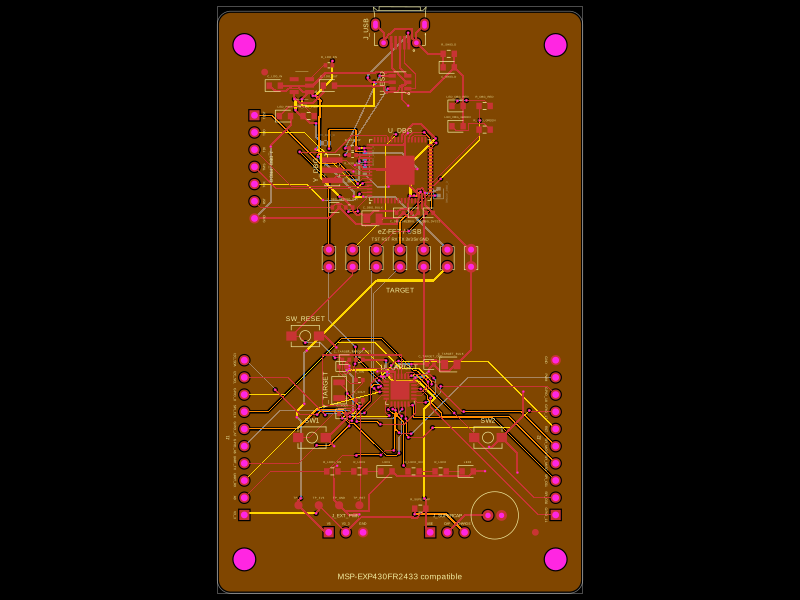
Fabrication-ready four-layer recreation of TI's LP-MSP430FR2476 LaunchPad. The design follows the four reference schematic sheets in TI SLAU802: eZ-FET host/USB, power, target and 40-pin headers, and LEDs/switches/sensor/battery.

## Implemented hardware

- MSP430FR2476TPT target in LQFP-48 with SBW programming and reset network
- MSP430F5528 eZ-FET host, protected Micro-USB data path, backchannel UART, and seven removable isolation links
- Conventional TLV70033 3.3 V LDO in place of TI's patented EnergyTrace switcher
- Standard 40-pin LaunchPad / BoosterPack header mapping
- 32.768 kHz crystal with removable 0 ohm links and 12 pF load capacitors
- S1 on P4.0, S2 on P2.3, reset button, green P1.0 LED, and RGB LED on P5.1/P5.0/P4.7
- TMP235A2 temperature sensor routed to A1/P1.1 through a removable power link and RC filter
- Bottom-side CR2032 holder with reverse-current diode and removable source jumper
- Four mounting holes, two fiducials, four copper layers, BOM, and pick-and-place output

For USB operation, fit all seven eZ-FET isolation shunts and leave the battery jumper open. For CR2032 operation, disconnect the eZ-FET 3V3 path and install the battery jumper. Remove `R_XIN` and `R_XOUT` if P2.1/P2.0 must be used as header GPIO instead of the 32.768 kHz crystal.

EnergyTrace current profiling is not implemented. The board remains programmable, debuggable, USB-UART capable, BoosterPack-compatible, and independently battery operable.

## Fabrication checks

- tscircuit `0.0.2332`
- default autorouter: 174 PCB traces and 173 vias
- via geometry: 0.30 mm finished hole, 0.45 mm pad
- Circuit JSON errors: 0
- source, readable-netlist, and placement checks: 0 errors and 0 warnings
- Gerber all-layer shorts check: clean at the default resolution and at 40 pixels/mm
- Gerber archive includes front/back/inner copper, masks, paste, silkscreen, edge cuts, plated drill, NPTH drill, BOM, and pick-and-place files

The two 32.768 kHz branches produce 10.25 mm and 12.14 mm advisory-length warnings against tscircuit's built-in 10 mm crystal limit. They are low-frequency, obstacle-aware routes and do not produce Circuit JSON DRC or Gerber-short errors.

## Rebuild

```sh
bun install
bunx tsci build
bunx tsci check source
bunx tsci check netlist
bunx tsci check placement
bunx tsci export index.circuit.tsx --format gerbers --output dist/gerbers.zip
bunx tsci check shorts index.circuit.tsx --mode gerber --layer all
bunx tsci check shorts index.circuit.tsx --mode gerber --layer all --pixels-per-mm 40
```

References: [TI LP-MSP430FR2476 product page](https://www.ti.com/tool/LP-MSP430FR2476), [TI SLAU802 user guide](https://www.ti.com/lit/ug/slau802/slau802.pdf), and [MSP430FR2476 datasheet](https://www.ti.com/lit/ds/symlink/msp430fr2476.pdf).