AnasSarkiz/magnetic-shutter-remote-r8
A USB‑C rechargeable battery-powered ESP32‑C3 wireless controller with Li‑ion charging, protected 3.3‑V buck‑boost regulation, thermal/safety monitoring, status LEDs, buttons, programming UART, crystal clock, and 2.4‑GHz antenna matching network.
- Version
- 0.4.0-prototype
- License
- unset
- Stars
- 0
scripts/normalize-pcb-model.ts
import { mat3, mat4, quat, vec3 } from "gl-matrix";
import { z } from "zod";

/** Lossless assembly interchange: native (-PCB X,PCB Z,PCB Y) to product XYZ.
 * Use a proper rotation and the documented z+ normal in both browser and CLI.
 * Flatten scene transforms and give each mesh instance
 * its own record; all accessors, triangles, materials and binary bytes survive.
 */
export function pcbModelInAssemblyCoordinates(
	glb: ArrayBuffer,
	{ rotationDegrees }: { rotationDegrees: number },
): Uint8Array {
	const source = new Uint8Array(glb),
		view = new DataView(glb);
	if (view.getUint32(0, true) !== 0x46546c67 || view.getUint32(4, true) !== 2)
		throw new Error("Expected glTF 2 GLB");
	const jsonLength = view.getUint32(12, true);
	const triple = z.tuple([z.number(), z.number(), z.number()]);
	const document = z
		.object({
			nodes: z.array(
				z
					.object({
						name: z.string().optional(),
						mesh: z.number().optional(),
						children: z.array(z.number()).optional(),
						translation: triple.optional(),
						rotation: z
							.tuple([z.number(), z.number(), z.number(), z.number()])
							.optional(),
						scale: triple.optional(),
						matrix: z.array(z.number()).length(16).optional(),
					})
					.passthrough(),
			),
			meshes: z.array(z.record(z.unknown())),
			scenes: z.array(z.object({ nodes: z.array(z.number()) }).passthrough()),
		})
		.passthrough()
		.parse(
			JSON.parse(new TextDecoder().decode(source.slice(20, 20 + jsonLength))),
		);
	const nodes: typeof document.nodes = [],
		meshes: typeof document.meshes = [];
	const loaderFromExport = mat4.multiply(
		mat4.create(),
		mat4.fromZRotation(mat4.create(), (rotationDegrees * Math.PI) / 180),
		mat4.fromValues(-1, 0, 0, 0, 0, 0, 1, 0, 0, 1, 0, 0, 0, 0, 0, 1),
	);
	function visit(index: number, parent: mat4) {
		const node = document.nodes[index];
		const local = node.matrix
			? mat4.clone(node.matrix)
			: mat4.fromRotationTranslationScale(
					mat4.create(),
					node.rotation ?? [0, 0, 0, 1],
					node.translation ?? [0, 0, 0],
					node.scale ?? [1, 1, 1],
				);
		const world = mat4.multiply(mat4.create(), parent, local);
		if (node.mesh !== undefined) {
			const translation = vec3.create(),
				scale = vec3.create();
			mat4.getTranslation(translation, world);
			mat4.getScaling(scale, world);
			if (mat4.determinant(world) < 0) scale[0] *= -1;
			if (Array.from(scale).some((n) => Math.abs(n) < 1e-10))
				throw new Error("Degenerate model transform");
			const basis = mat3.fromMat4(mat3.create(), world);
			for (let axis = 0; axis < 3; axis++)
				for (let row = 0; row < 3; row++) basis[axis * 3 + row] /= scale[axis];
			const rotation = quat.normalize(
				quat.create(),
				quat.fromMat3(quat.create(), basis),
			);
			const rebuilt = mat4.fromRotationTranslationScale(
				mat4.create(),
				rotation,
				translation,
				scale,
			);
			if (Array.from(world).some((n, i) => Math.abs(n - rebuilt[i]) > 1e-5))
				throw new Error("Unsupported sheared model transform");
			const mesh = meshes.length;
			meshes.push({ ...document.meshes[node.mesh] });
			nodes.push({
				name: node.name,
				mesh,
				translation: triple.parse(Array.from(translation)),
				rotation: z
					.tuple([z.number(), z.number(), z.number(), z.number()])
					.parse(Array.from(rotation)),
				scale: triple.parse(Array.from(scale)),
			});
		}
		for (const child of node.children ?? []) visit(child, world);
	}
	const scenes = document.scenes.map((scene) => {
		const start = nodes.length;
		for (const root of scene.nodes) visit(root, loaderFromExport);
		return {
			...scene,
			nodes: Array.from({ length: nodes.length - start }, (_, i) => start + i),
		};
	});
	const encoded = new TextEncoder().encode(
		JSON.stringify({ ...document, nodes, meshes, scenes }),
	);
	const paddedLength = Math.ceil(encoded.length / 4) * 4;
	const tail = source.slice(20 + jsonLength),
		output = new Uint8Array(20 + paddedLength + tail.length),
		header = new DataView(output.buffer);
	header.setUint32(0, 0x46546c67, true);
	header.setUint32(4, 2, true);
	header.setUint32(8, output.length, true);
	header.setUint32(12, paddedLength, true);
	header.setUint32(16, 0x4e4f534a, true);
	output.fill(32, 20, 20 + paddedLength);
	output.set(encoded, 20);
	output.set(tail, 20 + paddedLength);
	if (
		!output
			.slice(20 + paddedLength)
			.every((byte, index) => byte === tail[index])
	)
		throw new Error("Binary geometry changed");
	return output;
}
Related Packages
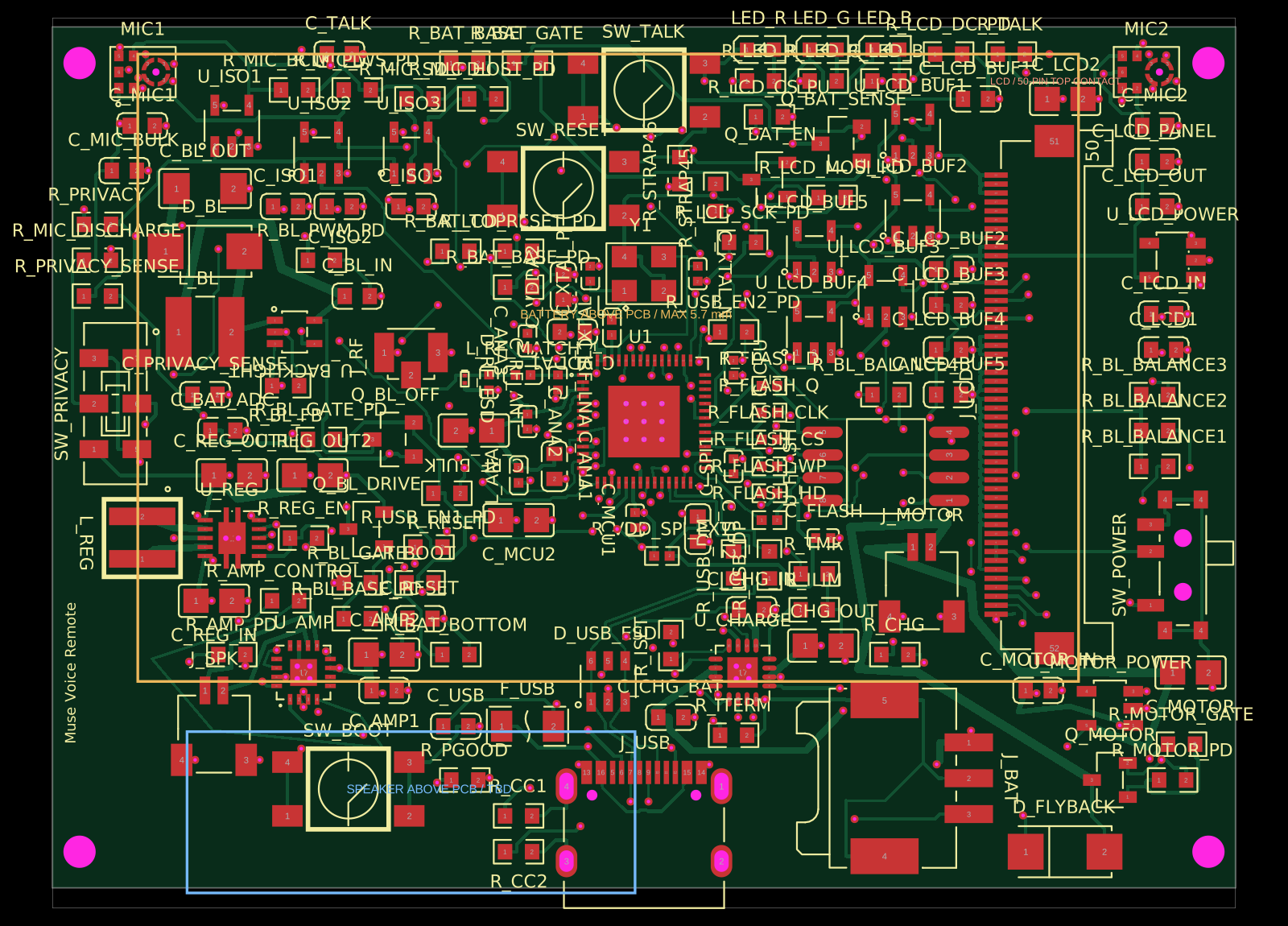 More from this authorAnasSarkiz/muse-voice-remoteMuse Voice Remote v1.3.0: checked prototype PCB/PCBA handoff. Bare ESP32-S3R8 chip, 155 TOP parts from 56 stocked JLCPCB imports with supplier CAD retained. Exact ER-TFT028A2-4 no-touch LCD, dual microphones, TALK, physical privacy, Wi-Fi, speaker, haptic and USB-C. Includes circuit.json, Gerbers/drills, JLC BOM/CPL, segmented stencil artwork and 19 filled/capped thermal-hole map. Native/factory DRC clean; 20 tests pass. See manufacturing/FABRICATION-NOTES.md for stackup and assembly requirements. Physical device/enclosure/RF qualification, firmware and connected-service MUSE integration remain unverified.
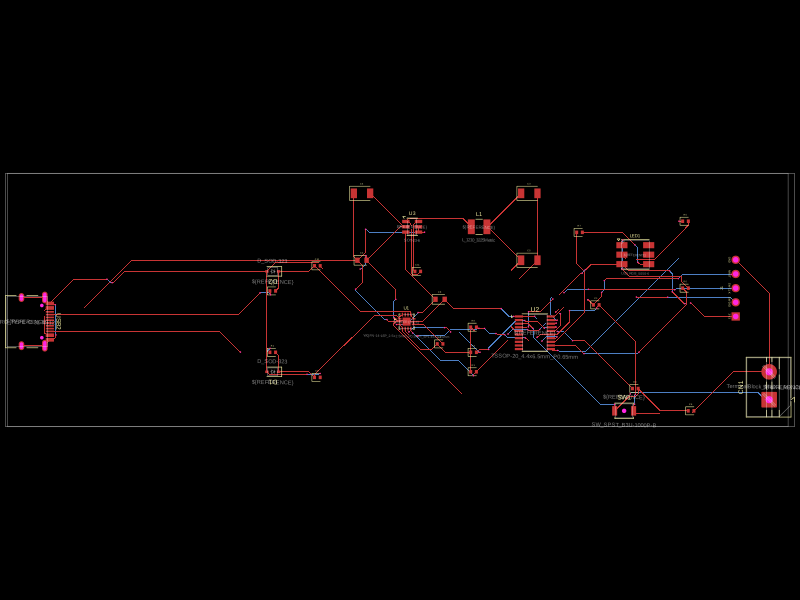 Similar packageaura/diy-power-delivery-triggerThis hardware design implements a USB Type-C port with supporting power management and signal conditioning components, including a USB-C connector, a FUSB302 USB-C port controller, ESD protection diodes, a buck converter for 3.3V power regulation, an STM32 microcontroller for control and processing, an RGB LED indicator, push button, terminal block connections, and associated filtering and support components.
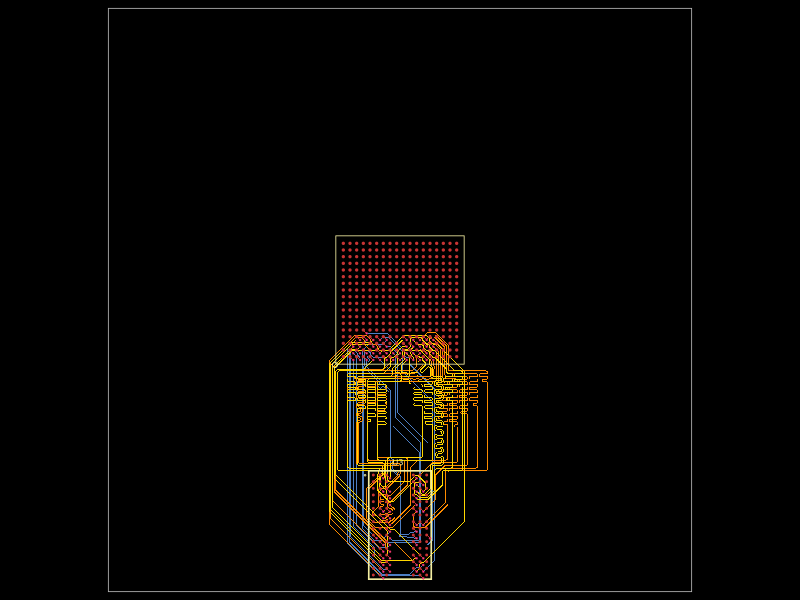 Discover something newseveibar/am3352-ram-dogbone-and-single-layer-route-testAM3352BZCZ100 processor connected to a W631GG6MB-12 DDR3 memory chip through a routed, length-matched 16-bit DDR interface with clock/data-strobe pairs and control/address signals.