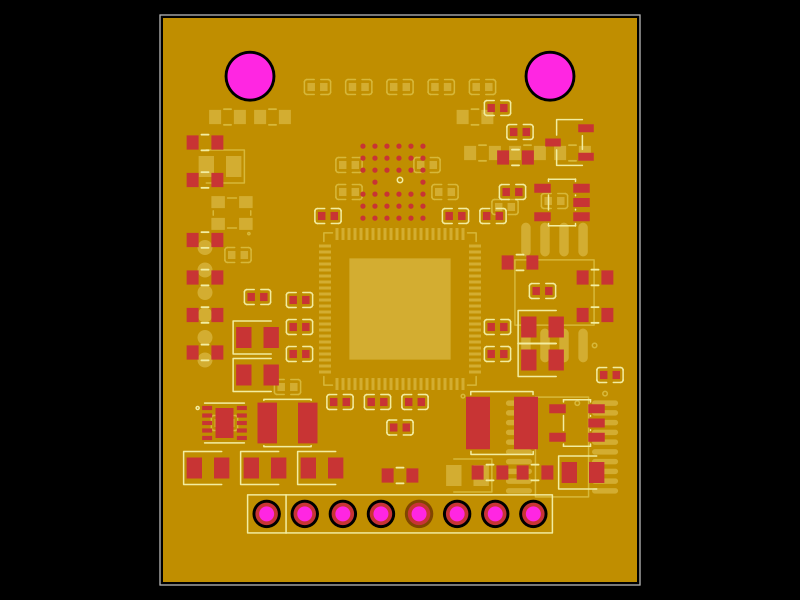
0hmX/dual-usb-peltier-assembly
A tscircuit package created by 0hmX.
- Version
- 0.4.12
- License
- unset
- Stars
- 0
tests/physical-copper.test.ts
import { describe, expect, test } from "bun:test"
import type { AnyCircuitElement } from "circuit-json"
import { analyzePhysicalCopper, sourceConnectivity } from "./helpers/physical-copper"

function fixture(): AnyCircuitElement[] {
  const json: any[] = [{ type: "pcb_board", num_layers: 4 }, { type: "source_net", source_net_id: "n", name: "SIGNAL" }]
  for (const [i, x] of [0, 2, 4].entries()) {
    json.push(
      { type: "source_component", source_component_id: `c${i}`, name: `P${i}` },
      { type: "source_port", source_port_id: `s${i}`, source_component_id: `c${i}`, name: "pin1", pin_number: 1 },
      { type: "pcb_port", pcb_port_id: `p${i}`, source_port_id: `s${i}`, x, y: 0, layers: ["top"] },
      { type: "pcb_smtpad", pcb_smtpad_id: `pad${i}`, pcb_port_id: `p${i}`, shape: "rect", x, y: 0, width: 0.6, height: 0.6, layer: "top" })
    if (i < 2) json.push({ type: "source_trace", source_trace_id: `st${i}`, connected_source_port_ids: [`s${i}`], connected_source_net_ids: ["n"] })
  }
  return json
}
const trace = (layer = "top", x0 = 0, x1 = 2): AnyCircuitElement => ({ type: "pcb_trace", pcb_trace_id: `trace${x0}`,
  source_trace_id: "st0", route: [x0, x1].map(x => ({ route_type: "wire", x, y: 0, width: 0.2, layer })) }) as AnyCircuitElement
const via = (x: number): AnyCircuitElement => ({ type: "pcb_via", pcb_via_id: `arbitrary-via-${x}`, x, y: 0,
  outer_diameter: 0.5, hole_diameter: 0.2, layers: ["top", "bottom"] }) as AnyCircuitElement
const ring = (coordinates: number[][]) => ({ vertices: coordinates.map(([x, y]) => ({ x, y })) })

describe("physical copper connectivity oracle", () => {
  test("logical net and trace IDs do not connect isolated copper islands", () => {
    const baseline = fixture(), expected = sourceConnectivity(baseline)
    expect(analyzePhysicalCopper(baseline, expected).disconnected).toHaveLength(1)
    expect(analyzePhysicalCopper([...baseline, trace("top", 0, 0.7), trace("top", 1.3, 2)], expected).disconnected).toHaveLength(1)
  })
  test("real copper joins required pins and ignores a genuinely unused pin", () => {
    const result = analyzePhysicalCopper([...fixture(), trace()])
    expect(result.disconnected).toEqual([])
    expect(result.shorts).toEqual([])
    expect(result.requiredPortCount).toBe(2)
    expect(result.ignoredNcPortCount).toBe(1)
  })
  test("current package flow-through conductors preserve the original source net partition", () => {
    const baseline = fixture() as any[]
    const pin = baseline.find(e => e.source_port_id === "s1" && e.type === "source_port")
    pin.source_component_id = "c0"
    pin.pin_number = 2
    const expected = sourceConnectivity(baseline)
    const current = [...baseline, { type: "source_component_internal_connection", source_component_id: "c0",
      source_port_ids: ["s0", "s1"] }]
    expect(sourceConnectivity(current).signature).toBe(expected.signature)
    expect(analyzePhysicalCopper(baseline, expected).disconnected).toHaveLength(1)
    expect(analyzePhysicalCopper(current, expected).disconnected).toEqual([])
  })
  test("bottom copper cannot contact top-only pads", () => {
    expect(analyzePhysicalCopper([...fixture(), trace("bottom")]).disconnected).toHaveLength(1)
  })
  test("top-to-bottom barrels connect inner copper and arbitrary via IDs count", () => {
    const result = analyzePhysicalCopper([...fixture(), via(0), via(2), trace("inner1")])
    expect(result.disconnected).toEqual([])
    expect(result.metricsForNet("SIGNAL")).toEqual({ traceLengthMm: 2, viaCount: 2 })
  })
  test("native wire-to-via points include the copper leading into and out of a barrel", () => {
    const json = fixture() as any[]
    json.find(e => e.pcb_smtpad_id === "pad1").layer = "bottom"
    const routed: any = { type: "pcb_trace", pcb_trace_id: "implicit", route: [
      { route_type: "wire", x: 0, y: 0, width: 0.2, layer: "top" },
      { route_type: "via", x: 1, y: 0, from_layer: "top", to_layer: "bottom" },
      { route_type: "wire", x: 2, y: 0, width: 0.2, layer: "bottom" },
    ] }
    const result = analyzePhysicalCopper([...json, via(1), routed])
    expect(result.disconnected).toEqual([])
    expect(result.unanchoredCopper).toEqual([])
    expect(result.metricsForNet("SIGNAL")).toEqual({ traceLengthMm: 2, viaCount: 1 })
  })
  test("through-pad paths require real plated copper between their two layers", () => {
    const json = fixture() as any[]
    json.find(e => e.pcb_smtpad_id === "pad1").layer = "bottom"
    const routed: any = { type: "pcb_trace", pcb_trace_id: "pad-path", route: [
      { route_type: "wire", x: 0, y: 0, width: 0.2, layer: "top" },
      { route_type: "through_pad", start: { x: 0.8, y: 0 }, end: { x: 1.2, y: 0 }, start_layer: "top", end_layer: "bottom", width: 0.2 },
      { route_type: "wire", x: 2, y: 0, width: 0.2, layer: "bottom" },
    ] }
    expect(analyzePhysicalCopper([...json, routed]).disconnected).toHaveLength(1)
    const hole: any = { type: "pcb_plated_hole", pcb_plated_hole_id: "plated", shape: "circle", x: 1, y: 0,
      outer_diameter: 0.5, hole_diameter: 0.2, layers: ["top", "bottom"] }
    expect(analyzePhysicalCopper([...json, hole, routed]).disconnected).toEqual([])
  })
  test("a repeated wire endpoint inside a drilled via is not a floating copper disk", () => {
    const routed: any = { type: "pcb_trace", pcb_trace_id: "stub", route: [
      { route_type: "wire", x: 0, y: 0, width: 0.1, layer: "top" },
      { route_type: "wire", x: 1, y: 0, width: 0.1, layer: "top" },
      { route_type: "via", x: 1, y: 0, from_layer: "top", to_layer: "bottom" },
      { route_type: "wire", x: 1, y: 0, width: 0.1, layer: "bottom" },
    ] }
    expect(analyzePhysicalCopper([...fixture(), via(1), routed]).unanchoredCopper).toEqual([])
  })
  test("a pour hole isolates copper inside it", () => {
    const pour: any = { type: "pcb_copper_pour", pcb_copper_pour_id: "pour", shape: "brep", layer: "top", source_net_id: "n",
      brep_shape: { outer_ring: ring([[-1, -1], [3, -1], [3, 1], [-1, 1]]),
        inner_rings: [ring([[1.5, -0.5], [2.5, -0.5], [2.5, 0.5], [1.5, 0.5]])] } }
    expect(analyzePhysicalCopper([...fixture(), pour]).disconnected).toHaveLength(1)
    pour.brep_shape.inner_rings = []
    expect(analyzePhysicalCopper([...fixture(), pour]).disconnected).toEqual([])
  })
  test("touching an NC pad is an unintended connection", () => {
    expect(analyzePhysicalCopper([...fixture(), trace("top", 0, 4)]).shorts).toHaveLength(1)
  })
  test("source-net mutation remains visible even when copper connects the pins", () => {
    const baseline = fixture(), altered = structuredClone(baseline) as any[]
    altered.find(e => e.source_trace_id === "st1").connected_source_net_ids = []
    const result = analyzePhysicalCopper([...altered, trace()], sourceConnectivity(baseline))
    expect(result.sourceSignature).not.toBe(sourceConnectivity(baseline).signature)
  })
  test("a 0.095 mm gap fails a 0.1 mm rule without a tolerance waiver", () => {
    const json = fixture() as any[]
    json.find(e => e.pcb_smtpad_id === "pad2").x = 2.695
    const violations = analyzePhysicalCopper(json).clearanceViolations
    expect(violations).toHaveLength(1)
    expect(violations[0]!.actual).toBeCloseTo(0.095, 9)
    expect(violations[0]!.minimum).toBe(0.1)
  })
})
Related Packages
 More from this author0hmX/arducam-mini-2mp-plus-b0067-cloneThis code defines React components representing various hardware electronic components such as sensors, chips, capacitors, inductors, and memory devices, including their physical pin layouts, footprints, and 3D CAD models for PCB design integration.
 Discover something newimrishabh18/corne-keyboardA 3D-printed PLA enclosure for each Corne keyboard half, mounting the PCB with a base, plate, countersunk M3 fasteners, and optional switches/keycaps in exploded-view assembly.