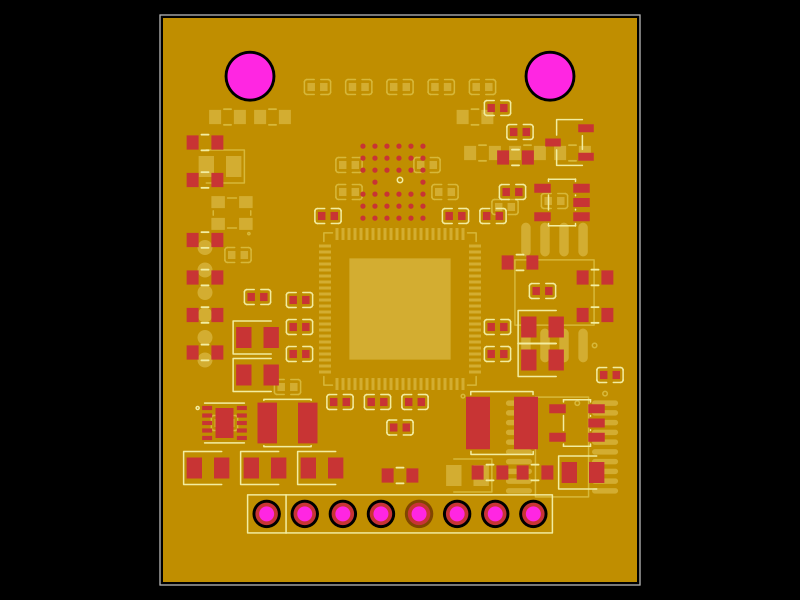
0hmX/dual-usb-peltier-assembly
A tscircuit package created by 0hmX.
- Version
- 0.4.12
- License
- unset
- Stars
- 0
tests/helpers/physical-copper.ts
import { Arc, Box, Circle, Point, Polygon, Segment, Vector } from "@flatten-js/core"
import Flatbush from "flatbush"
import type { AnyCircuitElement } from "circuit-json"

// Geometry tolerance only (1 nm), never a manufacturing-clearance exemption.
const EPS = 1e-6
type Element = AnyCircuitElement & Record<string, any>
type Node = { shape: Polygon; layer: string; id: string; type: string; port?: string }
class Union {
  parents = new Map<string, string>()
  root(id: string): string {
    const parent = this.parents.get(id)
    if (!parent) { this.parents.set(id, id); return id }
    if (parent === id) return id
    const root = this.root(parent)
    this.parents.set(id, root)
    return root
  }
  join(ids: string[]) {
    if (!ids.length) return
    const first = this.root(ids[0]!)
    for (const id of ids.slice(1)) this.parents.set(this.root(id), first)
  }
}
const append = <T>(map: Map<string, T[]>, key: string, value: T) =>
  map.set(key, [...map.get(key) ?? [], value])

export function sourceConnectivity(json: AnyCircuitElement[]) {
  const elements = json as Element[]
  const components = new Map(elements.filter(e => e.type === "source_component").map(e => [e.source_component_id, e]))
  const union = new Union(), internal: string[][] = []
  for (const e of elements) {
    if (e.type === "source_trace") union.join([...e.connected_source_port_ids, ...e.connected_source_net_ids])
    if (e.type === "source_component") internal.push(...e.internally_connected_source_port_ids ?? [])
    if (e.type === "source_component_internal_connection") internal.push(e.source_port_ids)
  }
  for (const ids of internal) union.join(ids)
  const ports = new Map<string, string>(), sourceToKey = new Map<string, string>()
  for (const port of elements.filter(e => e.type === "source_port" && components.has(e.source_component_id ?? ""))) {
    const key = `${components.get(port.source_component_id)!.name}.${port.pin_number ?? port.name}`
    if (ports.has(key)) throw new Error(`Duplicate physical pin identity: ${key}`)
    ports.set(key, port.source_port_id)
    sourceToKey.set(port.source_port_id, key)
  }
  const names = new Map<string, string[]>(), peers = new Map<string, string[]>()
  for (const e of elements.filter(e => e.type === "source_net")) append(names, union.root(e.source_net_id), e.name)
  for (const [key, id] of ports) append(peers, union.root(id), key)
  const groups = [...peers].map(([id, keys]) => ({ nets: [...names.get(id) ?? []].sort(), ports: keys.sort() }))
    .sort((a, b) => a.ports.join() < b.ports.join() ? -1 : a.ports.join() > b.ports.join() ? 1 : 0)
  const internalKeys = internal.map(ids => ids.map(id => sourceToKey.get(id)).filter((id): id is string => !!id))
  return { ports, groups, internalKeys, signature: JSON.stringify(groups) }
}
export type ExpectedConnectivity = ReturnType<typeof sourceConnectivity>

const point = (p: { x: number; y: number }) => new Point(p.x, p.y)
const disk = (x: number, y: number, r: number) => new Polygon(new Circle(new Point(x, y), r))
function rectangle(x: number, y: number, w: number, h: number, degrees = 0) {
  return new Polygon(new Box(-w / 2, -h / 2, w / 2, h / 2)).rotate(degrees * Math.PI / 180).translate(new Vector(x, y))
}
function stroke(a: { x: number; y: number }, b: { x: number; y: number }, r1: number, r2 = r1) {
  const length = Math.hypot(b.x - a.x, b.y - a.y)
  if (![a.x, a.y, b.x, b.y, r1, r2].every(Number.isFinite) || Math.min(r1, r2) <= 0)
    throw new Error("Invalid trace coordinate or width")
  if (length <= Math.abs(r1 - r2) + EPS) return r1 >= r2 ? disk(a.x, a.y, r1) : disk(b.x, b.y, r2)
  const angle = Math.acos((r1 - r2) / length)
  const lowerA = new Point(r1 * Math.cos(-angle), r1 * Math.sin(-angle))
  const lowerB = new Point(length + r2 * Math.cos(-angle), r2 * Math.sin(-angle))
  const upperA = new Point(r1 * Math.cos(angle), r1 * Math.sin(angle))
  const upperB = new Point(length + r2 * Math.cos(angle), r2 * Math.sin(angle))
  return new Polygon([
    new Segment(lowerA, lowerB), new Arc(new Point(length, 0), r2, -angle, angle, true),
    new Segment(upperB, upperA), new Arc(new Point(0, 0), r1, angle, 2 * Math.PI - angle, true),
  ]).rotate(Math.atan2(b.y - a.y, b.x - a.x)).translate(new Vector(a.x, a.y))
}
function capsule(x: number, y: number, w: number, h: number, degrees = 0) {
  const half = Math.abs(w - h) / 2, radius = Math.min(w, h) / 2
  return stroke({ x: w > h ? -half : 0, y: w > h ? 0 : -half },
    { x: w > h ? half : 0, y: w > h ? 0 : half }, radius)
    .rotate(degrees * Math.PI / 180).translate(new Vector(x, y))
}
function cutHole(outer: Polygon, hole: Polygon) {
  const orientation = outer.faces.values().next().value!.orientation()
  for (const boundary of hole.faces) {
    const face = outer.addFace(boundary.shapes)
    if (face.orientation() === orientation) face.reverse()
  }
  return outer
}
function padShape(e: Element, components: Map<string, Element>) {
  const { x, y } = e, rotation = e.ccw_rotation ?? 0
  if (e.type === "pcb_via") return cutHole(disk(x, y, e.outer_diameter / 2), disk(x, y, e.hole_diameter / 2))
  const plated = e.type === "pcb_plated_hole"
  const w = plated ? e.outer_width : e.width, h = plated ? e.outer_height : e.height
  let shape: Polygon
  if (e.shape === "circle") shape = disk(x, y, plated ? e.outer_diameter / 2 : e.radius)
  else if (["rect", "rotated_rect", "circle_with_rect_pad"].includes(e.shape)) shape = rectangle(x, y, w, h, rotation)
  else if (["pill", "rotated_pill", "oval"].includes(e.shape)) shape = capsule(x, y, w, h, rotation)
  else if (e.shape === "polygon") {
    shape = new Polygon(e.points.map(point))
    if (plated) shape = shape.rotate((components.get(e.pcb_component_id ?? "")?.rotation ?? 0) * Math.PI / 180).translate(new Vector(x, y))
  } else throw new Error(`Unsupported copper shape: ${e.type} ${e.shape}`)
  if (plated) cutHole(shape, e.hole_diameter ? disk(x, y, e.hole_diameter / 2) : capsule(x, y, e.hole_width, e.hole_height, rotation))
  return shape
}
function pourShape(e: Element) {
  if (e.shape === "rect") return rectangle(e.center.x, e.center.y, e.width, e.height, e.rotation)
  if (e.shape === "polygon") return new Polygon(e.points.map(point))
  if (e.shape !== "brep") throw new Error(`Unsupported pour shape: ${e.shape}`)
  const shape = new Polygon(e.brep_shape.outer_ring.vertices.map(point))
  for (const ring of e.brep_shape.inner_rings ?? []) cutHole(shape, new Polygon(ring.vertices.map(point)))
  return shape
}
function touches(a: Polygon, b: Polygon) {
  return a.contains(b.vertices[0]!) || b.contains(a.vertices[0]!) || a.distanceTo(b)[0] <= EPS
}

/** Drill webs are a fabrication constraint even when the copper shares a net. */
export function drillSmtClearanceViolations(json: AnyCircuitElement[], thermalPairs = new Set<string>()) {
  const elements = json as Element[], minimum = 0.15
  const components = new Map(elements.filter(e => e.type === "pcb_component").map(e => [e.pcb_component_id, e]))
  const pads = elements.filter(e => e.type === "pcb_smtpad").map(e => ({ id: e.pcb_smtpad_id, shape: padShape(e, components) }))
  const violations: { drill: string; pad: string; actual: number; minimum: number }[] = []
  if (!pads.length) return violations
  const index = new Flatbush(pads.length)
  for (const { shape } of pads) { const b = shape.box; index.add(b.xmin, b.ymin, b.xmax, b.ymax) }
  index.finish()
  for (const e of elements.filter(e => e.type === "pcb_via" || e.type === "pcb_plated_hole")) {
    const id = e[`${e.type}_id`]
    const drill = e.hole_diameter ? disk(e.x, e.y, e.hole_diameter / 2)
      : capsule(e.x, e.y, e.hole_width, e.hole_height, e.ccw_rotation ?? 0)
    const b = drill.box
    for (const i of index.search(b.xmin - minimum, b.ymin - minimum, b.xmax + minimum, b.ymax + minimum)) {
      const pad = pads[i]!
      if (e.type === "pcb_via" && thermalPairs.has(`via_in_pad_${id}_${pad.id}`)) continue
      const actual = touches(drill, pad.shape) ? 0 : drill.distanceTo(pad.shape)[0]
      if (actual < minimum - EPS) violations.push({ drill: id, pad: pad.id, actual, minimum })
    }
  }
  return violations
}

/** Endpoints inside real pad copper count even when displaced from pad center. */
export function copperPortContacts(json: AnyCircuitElement[]) {
  const elements = json as Element[]
  const components = new Map(elements.filter(e => e.type === "pcb_component").map(e => [e.pcb_component_id, e]))
  const ports = new Map(elements.filter(e => e.type === "pcb_port").map(e => [e.pcb_port_id, e]))
  const pads = elements.filter(e => e.type === "pcb_smtpad" || e.type === "pcb_plated_hole").map(e => ({
    element: e, shape: padShape(e, components), port: ports.get(e.pcb_port_id ?? ""),
    layers: (e.type === "pcb_smtpad" ? [e.layer] : e.layers) as string[],
  })).filter(pad => pad.port?.source_port_id)
  return (endpoints: { x: number; y: number; layers: string[] }[]) => new Set<string>(pads.filter(pad =>
    endpoints.some(endpoint => endpoint.layers.some(layer => pad.layers.includes(layer)) &&
      (pad.shape.contains(point(endpoint)) || pad.shape.distanceTo(point(endpoint))[0] <= EPS ||
        // Through-hole routes conventionally terminate at the drill center.
        (pad.element.type === "pcb_plated_hole" && Math.hypot(endpoint.x - pad.port!.x, endpoint.y - pad.port!.y) <= EPS))))
    .map(pad => pad.port!.source_port_id))
}

export function analyzePhysicalCopper(json: AnyCircuitElement[], expected = sourceConnectivity(json)) {
  const elements = json as Element[], current = sourceConnectivity(json)
  const board = elements.find(e => e.type === "pcb_board")!
  if (!board) throw new Error("Missing board")
  const stack = ["top", ...Array.from({ length: board.num_layers - 2 }, (_, i) => `inner${i + 1}`), "bottom"]
  const components = new Map(elements.filter(e => e.type === "pcb_component").map(e => [e.pcb_component_id, e]))
  const pcbPorts = new Map(elements.filter(e => e.type === "pcb_port").map(e => [e.pcb_port_id, e]))
  const sourceToKey = new Map([...current.ports].map(([key, id]) => [id, key]))
  const nodes: Node[] = [], union = new Union(), portNodes = new Map<string, string[]>()
  const segmentLengths = new Map<string, number>(), viaIds = new Set<string>(), invalid: string[] = []
  const add = (shape: Polygon, layer: string, id: string, type: string, port?: string) => {
    if (!stack.includes(layer)) throw new Error(`Unknown copper layer: ${layer}`)
    const index = String(nodes.length)
    nodes.push({ shape, layer, id, type, port }); union.root(index)
    if (port) append(portNodes, port, index)
    return index
  }
  for (const e of elements) {
    if (["pcb_smtpad", "pcb_plated_hole", "pcb_via"].includes(e.type)) {
      const shape = padShape(e, components), id = e[`${e.type}_id`]
      let layers = e.type === "pcb_smtpad" ? [e.layer] : e.layers ?? [e.from_layer ?? "top", e.to_layer ?? "bottom"]
      if (e.type !== "pcb_smtpad") {
        const indices = layers.map((layer: string) => stack.indexOf(layer))
        if (indices.includes(-1)) throw new Error(`Unknown barrel layer: ${id}`)
        layers = stack.slice(Math.min(...indices), Math.max(...indices) + 1)
      }
      const port = sourceToKey.get(pcbPorts.get(e.pcb_port_id ?? "")?.source_port_id ?? "")
      const ids = layers.map((layer: string) => add(shape, layer, id, e.type, port))
      if (e.type !== "pcb_smtpad") union.join(ids)
      if (e.type === "pcb_via") viaIds.add(id)
    } else if (e.type === "pcb_copper_pour") {
      const shape = pourShape(e)
      if (!shape.isValid()) invalid.push(e.pcb_copper_pour_id)
      add(shape, e.layer, e.pcb_copper_pour_id, e.type)
    } else if (e.type === "pcb_trace") {
      for (let i = 1; i < e.route.length; i++) {
        const a = e.route[i - 1], b = e.route[i]
        if (a.route_type === "via" && b.route_type === "via") continue
        const aPoint = a.route_type === "through_pad" ? a.end : a
        const bPoint = b.route_type === "through_pad" ? b.start : b
        const aLayer = a.route_type === "wire" ? a.layer : a.route_type === "via" ? a.to_layer : a.end_layer
        const bLayer = b.route_type === "wire" ? b.layer : b.route_type === "via" ? b.from_layer : b.start_layer
        if (aLayer !== bLayer) throw new Error(`Unplated layer transition: ${e.pcb_trace_id}`)
        // Native routes may omit repeated wire points at a via or pad boundary.
        // The pad itself must exist as real copper; metadata cannot bridge it.
        const aWidth = a.route_type !== "via" ? a.width : b.route_type !== "via" ? b.width : 0
        const bWidth = b.route_type !== "via" ? b.width : aWidth
        const length = Math.hypot(bPoint.x - aPoint.x, bPoint.y - aPoint.y)
        // A repeated endpoint entirely inside a drill leaves no fabricated
        // copper disk. The annular via/pad already models its real copper.
        if (length <= EPS && elements.some(hole =>
          (hole.type === "pcb_via" || hole.type === "pcb_plated_hole") && hole.hole_diameter &&
          Math.hypot(aPoint.x - hole.x, aPoint.y - hole.y) + Math.max(aWidth, bWidth) / 2 <= hole.hole_diameter / 2 + EPS)) continue
        const id = `${e.pcb_trace_id}:segment${i - 1}`
        add(stroke(aPoint, bPoint, aWidth / 2, e.route_thickness_mode === "interpolated" ? bWidth / 2 : aWidth / 2), aLayer, id, e.type)
        segmentLengths.set(id, length)
      }
    }
  }
  for (const ids of portNodes.values()) union.join(ids)
  // Preserve original package metal (USB shells) and include verified conductors
  // added to current component definitions (USBLC6 flow-through pins). Desired
  // electrical nets still come exclusively from the immutable expected graph.
  for (const keys of [...expected.internalKeys, ...current.internalKeys]) union.join(keys.flatMap(key => portNodes.get(key) ?? []))
  const layerIndices: { ids: number[]; index: Flatbush }[] = []
  for (const layer of stack) {
    const ids = nodes.flatMap((node, i) => node.layer === layer ? [i] : [])
    if (!ids.length) continue
    const index = new Flatbush(ids.length)
    for (const id of ids) { const b = nodes[id]!.shape.box; index.add(b.xmin, b.ymin, b.xmax, b.ymax) }
    index.finish()
    layerIndices.push({ ids, index })
    ids.forEach((id, i) => {
      const a = nodes[id]!.shape, b = a.box
      for (const j of index.search(b.xmin - EPS, b.ymin - EPS, b.xmax + EPS, b.ymax + EPS))
        if (j > i && touches(a, nodes[ids[j]!]!.shape)) union.join([String(id), String(ids[j])])
    })
  }
  const expectedNets = new Map<string, string[]>(), groups = [], disconnected = []
  let requiredPortCount = 0, ignoredNcPortCount = 0
  for (const group of expected.groups) {
    for (const key of group.ports) expectedNets.set(key, group.nets)
    if (!group.nets.length && group.ports.length === 1) { ignoredNcPortCount++; continue }
    requiredPortCount += group.ports.length
    const islands = new Map<string, string[]>()
    for (const port of group.ports) append(islands, portNodes.has(port) ? union.root(portNodes.get(port)![0]!) : `missing:${port}`, port)
    const result = { ...group, islands: [...islands.values()] }
    groups.push(result)
    if (islands.size > 1) disconnected.push(result)
  }
  const physicalGroups = new Map<string, string[]>()
  for (const [port, ids] of portNodes) if (expected.ports.has(port)) append(physicalGroups, union.root(ids[0]!), port)
  const shorts = [...physicalGroups.values()].flatMap(ports => {
    const nets = [...new Set(ports.map(port => expectedNets.get(port)?.join(",") || `NC:${port}`))]
    return nets.length > 1 ? [{ nets, ports }] : []
  })
  // Resolve copper nets only through physical contact with original pins. A
  // short cannot redefine the intended source nets: shorts above fail first.
  const rootNets = new Map([...physicalGroups].map(([root, ports]) => [root,
    [...new Set(ports.map(port => expectedNets.get(port)?.join(",") || `NC:${port}`))]]))
  const elementsById = new Map(elements.map(e => [e[`${e.type}_id`], e]))
  const namedNet = (id: string) => {
    const name = elementsById.get(id)?.name
    return expected.groups.find(group => group.nets.includes(name))?.nets.join(",")
  }
  const declaredNet = (element?: Element): string | undefined => {
    if (!element) return
    if (element.source_net_id) return namedNet(element.source_net_id)
    if (element.source_trace_id) {
      const trace = elementsById.get(element.source_trace_id)
      const key = trace?.connected_source_port_ids.map((id: string) => sourceToKey.get(id)).find((key: string) => expectedNets.has(key))
      return key ? expectedNets.get(key)?.join(",") : trace?.connected_source_net_ids.map(namedNet).find(Boolean)
    }
    if (element.type === "pcb_via" && element.pcb_trace_id) return declaredNet(elementsById.get(element.pcb_trace_id))
    const port = sourceToKey.get(pcbPorts.get(element.pcb_port_id ?? "")?.source_port_id ?? "")
    return port ? expectedNets.get(port)?.join(",") || `NC:${port}` : undefined
  }
  const copperNet = (node: Node, root: string) => {
    const actual = rootNets.get(root)
    // A unique physically anchored net always overrides replayed metadata.
    // For an open/shorted intermediate candidate only, declarations distinguish
    // intended same-net islands. Opens, shorts and floating copper still fail.
    return actual?.length === 1 ? actual[0] : declaredNet(elementsById.get(node.id.split(":segment")[0]))
  }
  const padGap = board.min_pad_edge_to_pad_edge_clearance ?? 0.1
  const traceGap = board.min_trace_to_pad_edge_clearance ?? 0.1
  const traceTraceGap = board.min_trace_to_trace_clearance ?? traceGap
  const viaGap = board.min_via_edge_to_pad_edge_clearance ?? padGap
  const maxGap = Math.max(padGap, traceGap, traceTraceGap, viaGap)
  const clearanceViolations: { a: string; b: string; layer: string; actual: number; minimum: number }[] = []
  const checkedPairs = new Set<string>()
  for (const { ids, index } of layerIndices) ids.forEach((id, i) => {
    const a = nodes[id]!, box = a.shape.box, aRoot = union.root(String(id))
    for (const j of index.search(box.xmin - maxGap, box.ymin - maxGap, box.xmax + maxGap, box.ymax + maxGap)) {
      if (j <= i) continue
      const b = nodes[ids[j]!]!, bRoot = union.root(String(ids[j]))
      const aNet = copperNet(a, aRoot), bNet = copperNet(b, bRoot)
      if (aRoot === bRoot || (aNet && aNet === bNet)) continue
      const pair = [a.id, b.id].sort().join("|")
      if (checkedPairs.has(pair)) continue
      const minimum = a.type === "pcb_trace" && b.type === "pcb_trace" ? traceTraceGap
        : a.type === "pcb_trace" || b.type === "pcb_trace" ? traceGap
        : a.type === "pcb_via" || b.type === "pcb_via" ? viaGap : padGap
      const actual = a.shape.distanceTo(b.shape)[0]
      if (actual < minimum - EPS) {
        clearanceViolations.push({ a: a.id, b: b.id, layer: a.layer, actual, minimum })
        checkedPairs.add(pair)
      }
    }
  })
  const metricsForNet = (name: string) => {
    const group = expected.groups.find(group => group.nets.includes(name))
    const roots = new Set(group?.ports.flatMap(port => (portNodes.get(port) ?? []).map(id => union.root(id))))
    const ids = new Set(nodes.filter((_, i) => roots.has(union.root(String(i)))).map(node => node.id))
    return { traceLengthMm: [...ids].reduce((sum, id) => sum + (segmentLengths.get(id) ?? 0), 0),
      viaCount: [...ids].filter(id => viaIds.has(id)).length }
  }
  const unanchoredCopper = [...new Set(nodes.filter((_, i) => !physicalGroups.has(union.root(String(i)))).map(node => node.id))]
  return { requiredPortCount, ignoredNcPortCount, groups, disconnected, shorts, invalid, unanchoredCopper, clearanceViolations,
    missingPorts: [...expected.ports.keys()].filter(port => !portNodes.has(port)),
    sourceSignature: current.signature, metricsForNet }
}
Related Packages
 More from this author0hmX/arducam-mini-2mp-plus-b0067-cloneThis code defines React components representing various hardware electronic components such as sensors, chips, capacitors, inductors, and memory devices, including their physical pin layouts, footprints, and 3D CAD models for PCB design integration.
 Discover something newimrishabh18/corne-keyboardA 3D-printed PLA enclosure for each Corne keyboard half, mounting the PCB with a base, plate, countersunk M3 fasteners, and optional switches/keycaps in exploded-view assembly.