0hmX/am3352-ddr-track-a-local-dfm-wip-20261007
Experimental RJ45-corrected board with isolated PG indication. 1005/1005 source joins pass; 15 expanded-guard physical errors, sourcing and qualification gates remain. Not fabrication-ready.
- Version
- 0.0.14
- License
- unset
- Stars
- 0
simulations-next/README.md
# Existing DDR simulation

`ibis.circuit.tsx` remains the simulation authority. Its native declarations are unchanged: 640 MT/s (1.5625 ns UI), 512 ns PRBS7, quiet and switching DQS cases, TI slow-9-mA driver and Winbond 60-ohm ODT. `channels.tsx` resolves actual CPU/RAM pads, including the existing DQ permutation. `ibis-models.tsx` declares the reviewed vendor models expected locally in `model-review/`.

First build and check the physical source:

```sh
bun run build
bun scripts/verify-ddr.tsx work/ddr/final
```

Run the native byte-0 write experiments from the project root:

```sh
bunx tsci simulate simulations-next/run-ddr.circuit.tsx --output work/ddr-run
```

The entry compiles the same physical TSX and nominal stackup as the verifier, supplies it to `ibis.circuit.tsx`, and lets the CLI serialize its native declarations. The saved-board bridge rejects existing simulation declarations, so this DDR-only entry removes the seven unrelated HDMI resistor-array SPICE subcircuits; all physical records are retained. Unexpected simulation records are still rejected by the bridge. `ibis.circuit.tsx` is a parameterized component, not a standalone CLI entry. To verify composition without running the solvers, run `bun test tests/ddr-simulation-entry.test.tsx`.

The currently pinned CLI contains the older pipeline at commit `63d15671`; with that version the above command reaches the pipeline but fails on the board's native via-hole field (`modeling_input: via_hole_diameter / hole_diameter must be a positive number`). A CLI release incorporating the upstream pipeline fix is needed before this command can progress past that error. Further extraction or solver failures may remain.

No accepted eye result exists for this routing. The previously observed native-via, channel-cut and sampled-copper preparation failures were addressed upstream in [pcb-spice-pipeline #9](https://github.com/tscircuit/pcb-spice-pipeline/pull/9), but the updated pipeline has not yet produced an accepted result for this layout. Its documented historical AM3352 routed-copper case still encounters a FastHenry numerical failure. These are tooling investigations, not reasons to change PCB geometry or relax numerical acceptance. Diagnostic evidence is isolated under ignored `work/bug-handoffs/simulation/`; no replacement simulation runner, clipping override, or curve simplifier is part of this board.

For review, compare the physical board and channel endpoints first, then require the native extraction/convergence checks to pass before viewing the declared DQ and DQS eyes. Inspect both quiet and switching-strobe experiments for each byte. A preview, a failed extraction, or an old eye image is not a result for this board.

The existing model omits other-net coupling, package parasitics and through-via stubs; material/plating properties and the nominal fabrication stackup remain assumptions. Power, VREF and support networks remain unfinished. These experiments cannot qualify the finished DDR interface.

Vendor IBIS files are not distributed in this repository. Obtain the TI and Winbond models under their applicable terms using the source URLs in `model-review/review-receipt.json`. The declarations expect `model-review/sprm552c-candidate-models.ibs` and `model-review/W631GG6MB-12.ibs`; the receipt records the reviewed TI subset transformation, model names and SHA-256 hashes. Verify locally supplied files against those hashes before comparing results. The receipt's historical evidence paths refer to a separate investigation and are not included here.
Related Packages
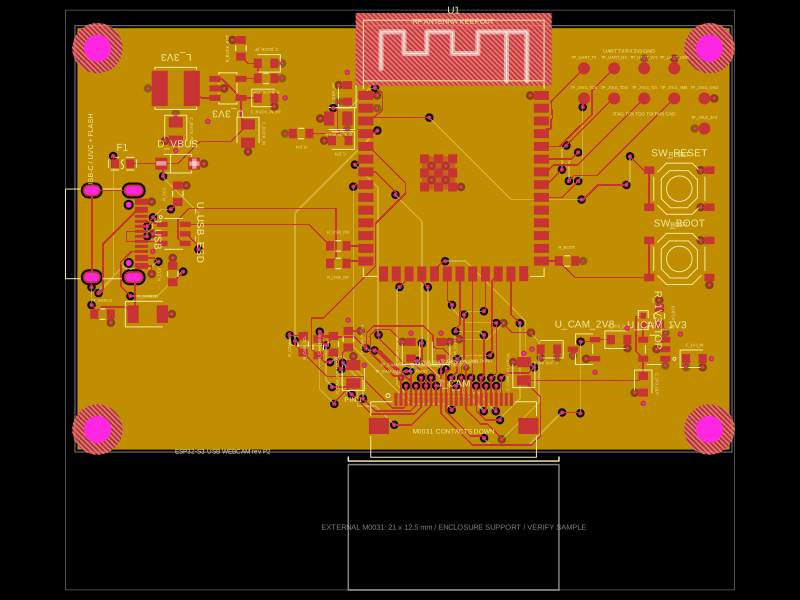 More from this author0hmX/esp32-s3-usb-webcam-ov2640This code defines and integrates a variety of surface-mount, through-hole, and connector hardware components (including microcontrollers, regulators, resistors, capacitors, and connectors) into a PCB design framework, enabling schematic symbol creation, footprint definition, and automated routing within an electronic circuit layout.
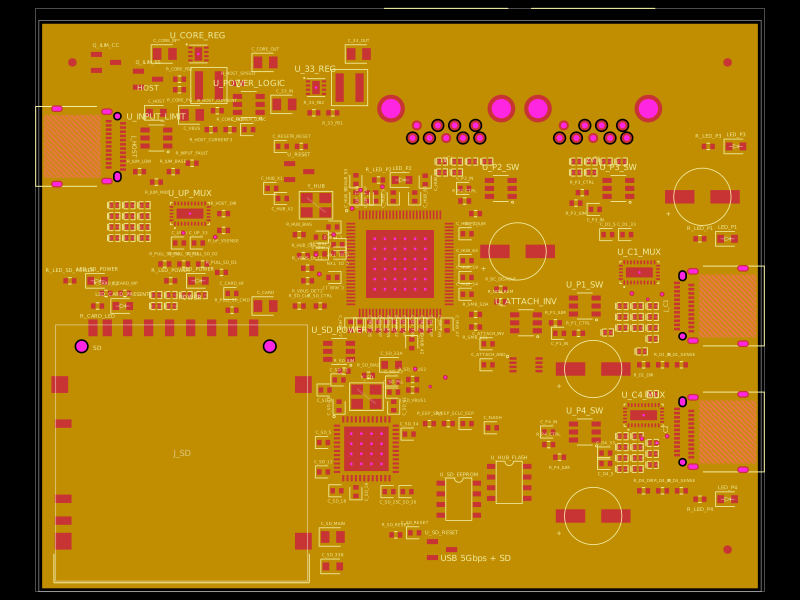 Similar packagegokul/usb3-sd-hubEngineering draft: four-layer, computer-powered USB 3 hub with one USB-C host socket, two USB-C and two USB-A accessory sockets, and a full-size SD slot. Board and three schematic previews are available. Routing and production checks are incomplete; not fabrication ready.
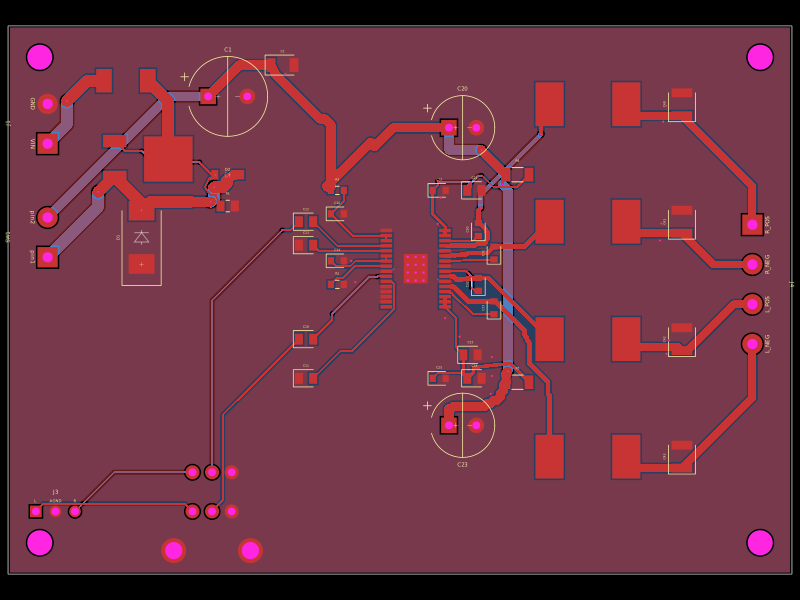 Discover something newhuntiep/radioA 12‑V car-powered stereo aux amplifier PCB using a TPA3118D2 class‑D BTL amp, protected power input, dual-gang volume control, LC speaker filters, and four-wire left/right speaker outputs.