tscircuit/boosters
This code defines PCB schematics, footprints, and 3D CAD models for various integrated circuits, connectors, sensors, and electronic components used in TI booster packs and modules.
- Version
- 0.1.19
- License
- unset
- Stars
- 0
boostxl-uln2003/README.md
# BOOSTXL-ULN2003 dual stepper-motor BoosterPack

Native tscircuit reconstruction of Texas Instruments' BOOSTXL-ULN2003 BoosterPack. The electrical design follows the official SLCU002 schematic and includes the fitted ULN2003 driver path, eighth CSD17571Q2 output, serial/parallel control, mode switches, status LEDs, motor connectors, supply protection, and DNP alternatives.

The design is organized into four schematic sheets: LaunchPad and mode selection, serial and parallel control, motor drivers and outputs, and motor supply and protection. The PCB uses four copper layers, explicit 0.50 mm motor-output routes, 0.30/0.45 mm via limits, and a bottom AGND copper pour.

This directory follows the source-only layout used by the other boards in this repository: the circuit entrypoint, TypeScript component imports, documentation, and canonical snapshots are tracked. Generated manufacturing files, caches, dependencies, and downloaded model assets are not stored here.

## Checks

Run from the repository root:

```sh
bun install
bun run typecheck
bun run build
bunx tsci check shorts boostxl-uln2003/index.circuit.tsx --mode pcb --layer top --pixels-per-mm 20
bunx tsci check shorts boostxl-uln2003/index.circuit.tsx --mode pcb --layer bottom --pixels-per-mm 10
bunx tsci snapshot boostxl-uln2003/index.circuit.tsx --3d --disable-parts-engine
```

## Source authority and release status

- Electrical connectivity, values, DNP choices, and switch mapping follow TI's BOOSTXL-ULN2003 user guide, SLCU002, especially Figure 26.
- Board placement and routing are reconstructed from the published board reference; TI's editable production archive is not available in this project.
- The design is suitable only for a small, current-limited first-article prototype order until physical fit, polarity, thermal behavior, flyback transients, and motor-load operation have been verified on the bench.
- Passing automated checks proves internal consistency and absence of detected copper shorts; it does not replace fabrication review or hardware validation.

Official reference: <https://www.ti.com/lit/ug/slcu002/slcu002.pdf>
Related Packages
 More from this authortscircuit/autorouting-dataset-01This code manages the hardware and electronic components for circuit design and PCB layout, defining components like resistors, capacitors, transistors, connectors, and footprints, and providing tools for component placement, PCB topology, and electrical connections.
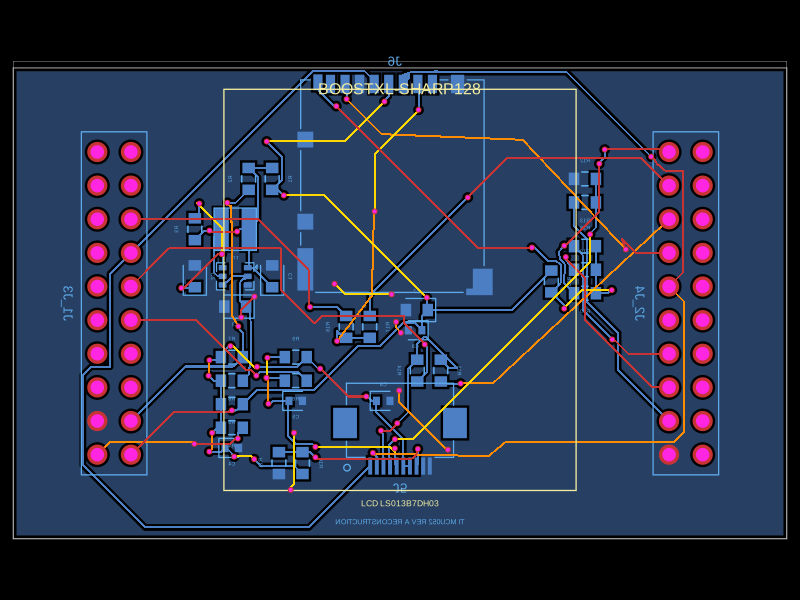 Similar packageabse/boostxl-sharp128This code defines a printed circuit board (PCB) with various surface-mount resistors, capacitors, inductors, and integrated circuits, including power management components and interface connectors, for a TI-based LCD and microSD module using 0603 and other package types.