shibosoftwaredev/f1c100s-linux-nema8-stepper-controller
Restores component part numbers and CAD models, removes test-point 3D bodies, and validates that solder paste exists only on top-side SMT pads without altering copper or DRC.
- Version
- 0.3.5
- License
- unset
- Stars
- 0
firmware/motor-control.py
#!/usr/bin/env python3
"""Reference Linux client for the STM32G030 NEMA8 motion controller.

The STM32, not Linux, generates STEP pulses and enforces the watchdog. Install
pyserial, program matching safety-reviewed MCU firmware, and keep the motor
mechanically unloaded during first bring-up.
"""

import argparse
import struct
import threading
import time


SYNC = b"\xA5\x5A"
VERSION = 1
CMD_HEARTBEAT = 0x01
CMD_ARM = 0x02
CMD_MOVE = 0x10
CMD_STOP = 0x11
CMD_DISABLE = 0x12
CMD_STATUS = 0x20
STATUS_TEXT = {
    0: "ok", 1: "bad command", 2: "bad argument", 3: "not armed",
    4: "busy", 5: "driver fault", 6: "over-temperature",
}


def crc16_ccitt(data: bytes) -> int:
    crc = 0xFFFF
    for byte in data:
        crc ^= byte << 8
        for _ in range(8):
            crc = ((crc << 1) ^ 0x1021) & 0xFFFF if crc & 0x8000 else (crc << 1) & 0xFFFF
    return crc


class MotionLink:
    def __init__(self, serial_port):
        self.serial = serial_port
        self.sequence = 0
        self.lock = threading.Lock()

    def _read_exact(self, length: int) -> bytes:
        data = self.serial.read(length)
        if len(data) != length:
            raise TimeoutError(f"motion MCU timeout ({len(data)}/{length} bytes)")
        return data

    def request(self, command: int, payload: bytes = b"") -> bytes:
        with self.lock:
            sequence = self.sequence
            self.sequence = (self.sequence + 1) & 0xFF
            body = struct.pack("<BBBH", VERSION, sequence, command, len(payload)) + payload
            self.serial.write(SYNC + body + struct.pack("<H", crc16_ccitt(body)))
            self.serial.flush()

            # Re-synchronise without accepting unbounded input.
            window = bytearray()
            for _ in range(64):
                window += self._read_exact(1)
                if window[-2:] == SYNC:
                    break
            else:
                raise RuntimeError("motion MCU response has no sync word")

            header = self._read_exact(5)
            version, response_sequence, response_command, length = struct.unpack("<BBBH", header)
            response_payload = self._read_exact(length)
            received_crc, = struct.unpack("<H", self._read_exact(2))
            if version != VERSION or response_sequence != sequence or response_command != (command | 0x80):
                raise RuntimeError("motion MCU response header mismatch")
            if received_crc != crc16_ccitt(header + response_payload):
                raise RuntimeError("motion MCU response CRC mismatch")
            if not response_payload:
                raise RuntimeError("motion MCU response has no status byte")
            status = response_payload[0]
            if status:
                raise RuntimeError(f"motion MCU rejected command: {STATUS_TEXT.get(status, status)}")
            return response_payload[1:]


def main():
    parser = argparse.ArgumentParser(description=__doc__)
    parser.add_argument("--port", default="/dev/ttyS0", help="F1C100S UART0 device")
    parser.add_argument("--steps", type=int, default=3200,
                        help="signed microsteps; 3200 is one revolution at fixed 1/16 mode")
    parser.add_argument("--hz", type=int, default=200, help="microsteps per second")
    parser.add_argument("--timeout", type=float, default=0.2, help="UART response timeout")
    parser.add_argument("--dry-run", action="store_true")
    args = parser.parse_args()
    if not -2_147_483_648 <= args.steps <= 2_147_483_647:
        parser.error("--steps is outside signed 32-bit range")
    if not 1 <= args.hz <= 100_000:
        parser.error("--hz must be between 1 and 100000")

    duration = abs(args.steps) / args.hz
    if args.dry_run:
        print(f"{args.steps} microsteps at {args.hz} microsteps/s ({duration:.3f} s), via {args.port}")
        return

    try:
        import serial
    except ImportError as error:
        raise SystemExit("pyserial is required: python3 -m pip install pyserial") from error

    stop_heartbeat = threading.Event()
    heartbeat_error = []
    with serial.Serial(args.port, 115200, timeout=args.timeout, write_timeout=args.timeout) as port:
        link = MotionLink(port)

        def heartbeat():
            while not stop_heartbeat.wait(0.08):
                try:
                    link.request(CMD_HEARTBEAT)
                except Exception as error:  # surfaced by the main loop
                    heartbeat_error.append(error)
                    stop_heartbeat.set()

        thread = threading.Thread(target=heartbeat, name="motion-heartbeat", daemon=True)
        try:
            link.request(CMD_DISABLE)
            link.request(CMD_STATUS)
            link.request(CMD_ARM, b"\x01")
            thread.start()
            link.request(CMD_MOVE, struct.pack("<iI", args.steps, args.hz))
            deadline = time.monotonic() + duration + 0.5
            while time.monotonic() < deadline and not stop_heartbeat.wait(0.05):
                pass
            if heartbeat_error:
                raise heartbeat_error[0]
            link.request(CMD_STATUS)
        except KeyboardInterrupt:
            link.request(CMD_STOP)
            raise
        finally:
            stop_heartbeat.set()
            if thread.is_alive():
                thread.join(timeout=0.2)
            try:
                link.request(CMD_DISABLE)
            except Exception:
                pass


if __name__ == "__main__":
    main()
Related Packages
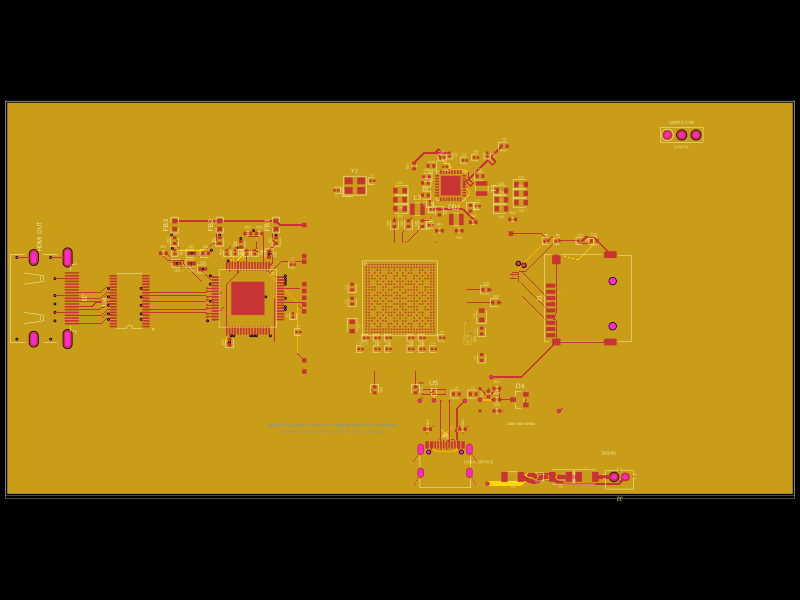 More from this authorShiboSoftwareDev/am625sip-linux-boardThis code defines the physical footprint and pin layout for an AM625 System-in-Package (SIP) component, detailing pad positions, pin labels, and package outline for hardware integration.
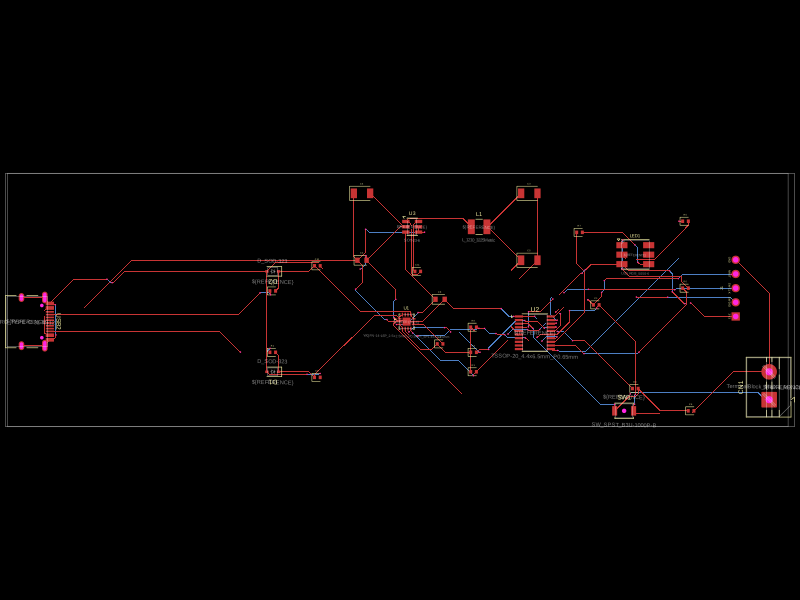 Similar packageaura/diy-power-delivery-triggerThis hardware design implements a USB Type-C port with supporting power management and signal conditioning components, including a USB-C connector, a FUSB302 USB-C port controller, ESD protection diodes, a buck converter for 3.3V power regulation, an STM32 microcontroller for control and processing, an RGB LED indicator, push button, terminal block connections, and associated filtering and support components.
 Discover something newtscircuit/standard-jst-programmer26 × 42 mm USB-C RP2040 programmer with JST and TC2030 IDC SWD, NRST, selectable sensed 5 V / 3.3 V power, RGB status, and importable JST SH/Tag-Connect targets. Top-side assembly.