seveibar/minimal-rp2040
This design features a Raspberry Pi RP2040 microcontroller with integrated decoupling capacitors, QSPI flash memory, crystal oscillator, and USB power circuitry, all mounted on a 65mm by 60mm four-layer PCB.
Usage: To import and use the RP2040 component in a tscircuit project: 1. Import the component: ```tsx import { RP2040 } from "@tsci/seveibar.minimal-rp2040" ``` 2. Use the component in a board: ```tsx <board> <RP2040 name="U3" pcbX={0} pcbY={0} connections={{ IOVDD1: "net.V3V3", // Add other required connections }} /> </board> ``` Key points: - Specify a name for the component - Set position using `pcbX` and `pcbY` - Define necessary network connections in the `connections` prop - Ensure proper power and ground connections
- Version
- 1.0.1
- License
- unset
- Stars
- 1
lib/thirdparty/InterconnectPga15x4Receiver.tsx
import type { ChipProps } from "@tscircuit/props"
import LGA15x4_net15 from "./PGA15x4_net15_bottomonly.json"

const COLS = 15
const ROWS = 4
const PITCH = 2.54 // 0.1 inch in mm

// Calculate grid dimensions
const gridWidth = (COLS - 1) * PITCH
const gridHeight = (ROWS - 1) * PITCH

// Build pin labels for all 60 pins
// Maps pin1-pin60 to P_R*_C* labels (row-major order)
const buildPinLabels = () => {
  const labels: Record<string, string> = {}
  let pinNum = 1
  for (let rowIndex = 0; rowIndex < ROWS; rowIndex++) {
    for (let colIndex = 0; colIndex < COLS; colIndex++) {
      labels[`pin${pinNum}`] = `P_R${rowIndex}_C${colIndex}`
      pinNum++
    }
  }
  return labels
}

const PIN_LABELS = buildPinLabels()
const PIN_LABEL_TO_NUMBER = Object.fromEntries(
  Object.entries(PIN_LABELS).map(([key, value]) => [value, key]),
)

// Build internally connected pins from the pin locations
// Pins with the same net number are internally connected
const buildInternallyConnectedPins = () => {
  const netGroups: Map<number, string[]> = new Map()

  // Group physical pins by their net number
  LGA15x4_net15.pinLocations.forEach((row, rowIndex) => {
    row.forEach((netNum, colIndex) => {
      const pinLabel = PIN_LABEL_TO_NUMBER[`P_R${rowIndex}_C${colIndex}`]
      if (!netGroups.has(netNum)) {
        netGroups.set(netNum, [])
      }
      netGroups.get(netNum)!.push(pinLabel)
    })
  })

  // Return array of arrays, where each inner array contains pins that are internally connected
  return Array.from(netGroups.values())
}

const internallyConnectedPins = buildInternallyConnectedPins()

// Build the footprint with all 60 plated holes
const PGA15x4ReceiverFootprint = () => {
  let pinNum = 1
  const holes: React.ReactNode[] = []

  for (let rowIndex = 0; rowIndex < ROWS; rowIndex++) {
    for (let colIndex = 0; colIndex < COLS; colIndex++) {
      const pinName = `pin${pinNum}`
      const isPin1 = pinNum === 1

      holes.push(
        <platedhole
          name={pinName}
          portHints={[pinName]}
          shape={isPin1 ? "circular_hole_with_rect_pad" : "circle"}
          holeDiameter={1.0}
          {...(isPin1
            ? { rectPadHeight: 1.8, rectPadWidth: 1.8 }
            : { outerDiameter: 1.8 })}
          pcbX={colIndex * PITCH - gridWidth / 2}
          pcbY={gridHeight / 2 - rowIndex * PITCH}
        />,
      )
      pinNum++
    }
  }

  return (
    <footprint>
      {holes}{" "}
      <silkscreenrect
        pcbX={0}
        pcbY={-2.54 * 1.5}
        width={gridWidth + 2.54}
        height={2.4}
      />
    </footprint>
  )
}

export const InterconnectPga15x4Receiver = (
  props: ChipProps<typeof PIN_LABELS> & {
    children?: any
  },
) => {
  const { children, ...rest } = props

  return (
    <interconnect
      {...rest}
      footprint={<PGA15x4ReceiverFootprint />}
      pinLabels={PIN_LABELS}
      internallyConnectedPins={internallyConnectedPins}
      doNotPlace
    >
      {children}
    </interconnect>
  )
}

export default InterconnectPga15x4Receiver
Related Packages
 More from this authortscircuit/autorouting-dataset-01This code manages the hardware and electronic components for circuit design and PCB layout, defining components like resistors, capacitors, transistors, connectors, and footprints, and providing tools for component placement, PCB topology, and electrical connections.
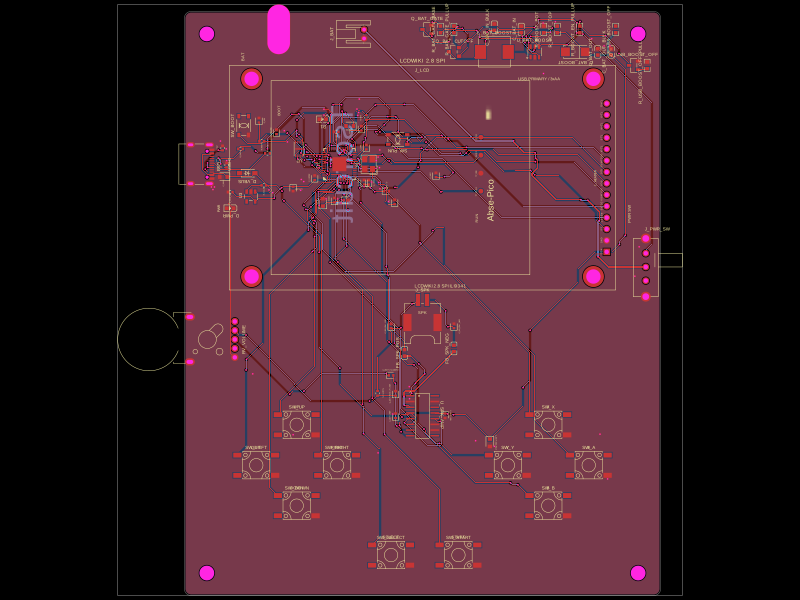 Similar packageabse/gameboyThis code defines the hardware mapping and schematic connections for a Raspberry Pi Pico-based development board featuring RP2040 microcontroller, USB-C connector, various power regulation components, decoupling capacitors, resistors, LEDs, headers, and supporting passive components for signal integrity and debugging.
 Discover something newimrishabh18/fitness_watchThis circuit integrates an ESP-12E microcontroller with various sensors, relays, and power management components, including an AO3400A transistor for switching loads, to enable wireless control and sensing functions.