rushabhcodes/fidget-counter
A tscircuit package created by rushabhcodes.
- Version
- 1.0.31
- License
- unset
- Stars
- 0
mechanical/printing/PRINTING.md
# PETG pilot print set

Use `mechanical/print-ready-manifest.json` and matching STL hashes. A unit uses **two rigid prints: Stationary_Base and one chosen Cap**. Circular is the starter; ten other caps are alternatives. No nut, retainer, top screws or split nest are used. Ten fit coupons are calibration prints.

Do **not** rigid-print electronic/display models or purchased bearings, screws, cells and magnets. The full assembly CAD is for inspection, not a single print-in-place object.

## Checked process assumptions

The provisional process is a Cartesian FDM printer with a **0.4 mm nozzle**, 1.75 mm PETG and at least a 220×220×200 mm build volume. The audit profile uses 0.15 mm layers, 0.20 mm first layer, nominal 0.45 mm extrusion width, four requested perimeters, six top/bottom layers and 100% rectilinear infill. Thick bridges are disabled so supported bonding/fixture roofs use the selected layer height rather than a round nozzle-width bridge bead projecting below the nominal face. Arachne varies line widths/count where features cannot hold four perimeters. Thin non-retaining rims are therefore not four-wall structures.

Starting temperatures are 230°C first layer, 240°C thereafter and 85°C bed; fan 30–50%, with bridge fan 100% after the first three layers. These are starting assumptions, not a qualified recipe for every PETG/printer. Use the actual machine/filament profile, correct bed surface/release treatment, calibrated extrusion and dimensional coupons. See [Prusa's PETG guidance](https://help.prusa3d.com/article/petg_2059), especially its bridging/overhang limitations.

`PETG-0.4-audit.ini` is a reproducible **geometry/slicing audit profile**, not complete machine setup. It has no printer-specific homing, probing or end sequence. The audit G-code stays in ignored `work/print-readiness`; **no machine G-code is shipped**. During qualification, slice each part separately with the listed mode. Import the meshes in the actual printer's slicer, apply its machine profile plus these support/orientation choices and inspect every layer before printing. Once qualified, batch using explicit per-object overrides; do not apply the noncircular caps’ early-only supports globally to a base. Never run audit G-code directly on a printer. Do not import the full audit INI over a qualified machine preset: retain its homing/probing/start/end sequences and copy only the relevant print/material/support settings.

## Orientation and supports

The supplied STLs already have the correct bed pose and Z minimum of zero. Do not use automatic orientation or scale them to fix a fit. A 3 mm outer brim is included in the audit profile; inspect adhesion and removal for the actual bed/material.

| File | Bed orientation | Support settings | Cleanup/check |
| --- | --- | --- | --- |
| Stationary_Base | Phone face down, fixed shaft up | `base-fixed-supports.ini`; enforce the first34 layers, support from bed and pocket floor, upper automatic supports off | Remove support from both the annular magnet seat and fixed bearing shoulder; inspect/clean the roof and verify ring/bondline seating. |
| Cap_circular, scalloped_coin, rounded_hexagon, wave_rim, turbine_wheel | Flat deck face down | Base profile, no supports | Bridge-labelled line lengths stay below the chosen 5 mm unsupported audit limit; inspect the actual printer preview. |
| Cap_ships_wheel, rounded_triangle, petal_flower, four_leaf_clover, rounded_square | Flat deck face down | `cap-early-rim-supports.ini`, reused for early rim support | Support the first annular drum expansion; remove from the exterior underside. Upper automatic supports remain off. |
| Cap_thumb_scoop | Upright, cup opening on bed, finger dishes up | `supports-everywhere.ini` inside the cup | Remove internal support; inspect bearing land, encoder pocket. This avoids treating shallow finger dishes as unsupported underside roofs. |

The base's magnet pocket is only 4.4 mm wide radially, but parallel toolpaths can span much longer tangential chords of the annulus. An unsupported control slice reported **floating bridge anchors and long bridging extrusions**. Therefore this PETG set explicitly supports the roof instead of calling it a 4.4 mm unsupported bridge.

Five noncircular caps use the early-rim support profile. The new ships-wheel geometry needs no support extrusion and slices without a warning; the other four still receive early support. Check the exact per-part results in the manifest rather than assuming all grip styles have identical support needs. The 5 mm unsupported criterion is a process assumption, not measured bridging qualification.

Print the ten bearing coupons first with the same process. The variants span shaftØ39.90/40.00/40.05/40.10 and housingØ52.10/52.00/51.95/51.90, plus the two nominal reference coupons. Their hashes are in [bearing-fit-coupons.json](../../validation/bearing-fit-coupons.json). Nominal product shaftØ40.05 and housingØ51.95 give0.05mm diametral interference on each race. This is not a qualified printer tolerance. Require hand-only seating, no hammer/press force through balls or shields, and measured pull-off/creep/service retention. Change explicit parameters and regenerate matching parts if needed; never scale a complete STL. There is no positive axial lock.

The new cap has no fastener recesses or reinforcing screw pads; bearing and encoder interfaces remain checked. The current cap lowers the phone-contact height to16.4mm. The fixed shaft has1.375mm nominal radial wall. Four PCB posts have0.8mm nominal pilot walls before screw forming/tapping; test actual screw retention. The common cap deck is1.3mm nominal, with1.2mm over the fixed encoder seat and0.9mm beneath the deepest existing thumb dish. Check print warp and roof quality against the0.78mm connector gap. Detailed source wall probes and actual toolpath results are in the validation reports.

## Reproduce the checks

With the Python requirements, Bun dependencies and a working PrusaSlicer CLI available:

```sh
python mechanical/build_enclosure.py --style all --assembly-style circular
python mechanical/build_fit_coupons.py
python mechanical/printing/audit_prints.py --slicer /path/to/prusa-slicer
```

The audit checks all twelve rigid product alternatives: valid single STEP solids, single closed oriented STL boundaries, source/bed transform and volume agreement, source-derived wall probes, bed contact and actual slicer execution. It requires no slicer print warnings, verifies support extrusion where required, and rejects unexpected supports on support-free parts. Reports and the manifest bind results to exact source/STL/profile hashes. Slicing is performed with the recorded CLI version; it is distinct from mesh checks and from a physical print test.

Inspect every layer of the actual machine's sliced job, especially the base roof and integral bearing shoulder and thumb-cap interior. Support removal may alter a mating/bonding surface; inspect and measure it before assembly. No split fixture is required for the selected light hand-only push-fit.

This set is for **controlled fit-test prints**. Physical print yield, bearing seating/pull-off force, creep, bearing fits and retention, magnetic bias, adhesive retention, Hall/BLE performance and firmware/end-of-line qualification remain separate production gates. Assembly-time savings are still estimates.
Related Packages
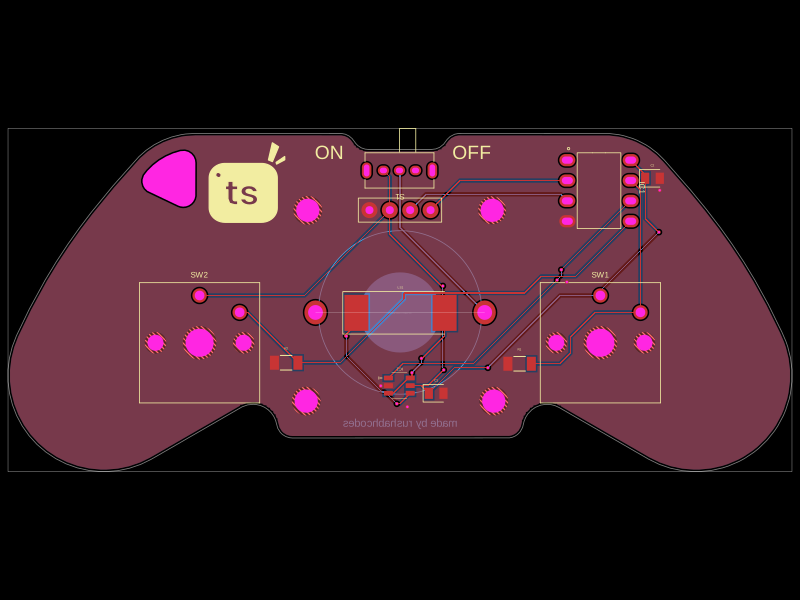 More from this authorrushabhcodes/Attiny85-Arcade-KeychainThis code defines a PCB and electronic component assembly for a compact ATtiny85-based gamepad keychain featuring power management, an OLED display, pushbutton inputs, audio piezo driver, and mechanical mounting, all mapped onto a custom PCB outline.
 Discover something newhrithik18k/switch-pcb