mohan-bee/compact-pir
Compact 3.3 V ESP8684 wireless motion/GPIO breakout board with LiPo regulation, 40 MHz crystal, U.FL antenna matching, digital PIR sensor, switched LED, decoupling, and dual 10-pin headers.
- Version
- 1.0.2
- License
- unset
- Stars
- 0
parts/compatibility-notes.md
# Final component sourcing

The selection covers all 34 board references: 32 SMT components and two male through-hole headers. All 22 selected supplier SKUs returned positive `stockCount` values from JLCPCB's public component-detail API on 24 October 2026. `selection.json` records each API URL, retrieval time, assembly process, Basic/Extended library classification and a separate LCSC stock snapshot. Stock is a snapshot, not reserved inventory. The SMT BOM contains 21 unique SKUs; the two headers share one additional SKU.

The requested ESP8684H4X (C48929155) and Senba S18-L262B-2 digital PIR (C2758472) remain unchanged. The PIR operates from 2.2–3.7V with 9.5µA typical consumption. Its pins are REL1, ONTIME2, OEN3, VDD4, SENS5 and VSS6. REL supplies the digital motion output; ONTIME and SENS use analog voltage settings. The AP2112, NPN, U.FL receptacle and 40MHz crystal retain their original imported footprints and pin maps. Newly selected passives keep the existing 0201, 0402 and 0603 package sizes.

## RF and oscillator parts

| References | Selection | Verified manufacturer ratings |
| --- | --- | --- |
| C10, C11 | Murata GJM0335C1E1R5WB01D, C435397 | 1.5pF ±0.05pF, 25V, C0G, High-Q family. Q ≥430 at 1MHz and ESR ≤0.30Ω at 1GHz. |
| L1 | Murata LQG15HS2N0S02D, C18216 | 2nH ±0.3nH, 900mA, DCR ≤0.09Ω, Q ≥8 at 100MHz, SRF ≥6GHz. Exceeds the required 600mA rating. |
| L2 | Murata LQP03TG2N7B02D, C86109 | 2.7nH ±0.1nH, 450mA, DCR ≤0.25Ω, Q ≥13 at 500MHz, SRF ≥11GHz. |
| L3 | Murata LQW15AN24NH00D, C913699 | 24nH ±3%, 280mA, DCR ≤0.52Ω, Q ≥25 at 250MHz, SRF ≥3.5GHz. |
| Y1 | SOSET/SST 3225 40M 12PF 10PPM, C5380316 | 40MHz, 12pF load, ±10ppm initial tolerance, ±30ppm stability, ESR ≤40Ω, 3225 four-pad package. |
| C12, C13 | Samsung CL05C180JB5NNNC, C307443 | 18pF ±5%, 50V, C0G, 0402. Preserves the latest circuit value. |

The specified Q test frequencies above must not be represented as guaranteed Q at 2.4GHz. The parts are appropriate RF families with suitable SRF, while matching values remain initial values that need VNA measurements on assembled hardware. Crystal startup and loaded frequency also require assembled-board validation.

C5380316 is the correct 40MHz/12pF/10ppm listing. Its manufacturer PDF and catalogue disagree on the upper operating temperature (+85°C versus +70°C), so use the conservative catalogue range of −20°C to +70°C until clarified. Initial tolerance and temperature stability are separate specifications.

If C5380316 cannot be procured or its listing changes, the concrete fallback is JSCJ C47089401, supplier MPN `40MHZ/3225/12PF/10PPM`, manufacturer drawing CJ13-400001210B20. It is 40MHz, 12pF, ±10ppm initial, ±20ppm stability and SMD3225-4P, with only 33 units reported by the JLC API at retrieval. It is recorded as an alternative, not substituted automatically; verify its pin map and oscillator behaviour before changing the BOM.

## Pads and assembly

- C10/C11/L2 fit the existing 0201 body class. Their exact imported EasyEDA land pattern is approximately 0.368 × 0.324mm pads at 0.549mm centre pitch. The routed board retains 0.460 × 0.400mm copper pads at 0.660mm pitch. The nominal paste design uses two equal 0.340 × 0.300mm openings per component, centred ±0.300mm along the terminal axis. This gives a 0.260mm paste gap, 0.030mm inner registration margin within the copper and 55.4% of the previous copper-area paste volume at equal foil thickness. On a 100µm stencil, area ratio is 0.797 and aspect ratio is 3.0. The nominal aperture area is 85.4% of the exact imported land area. These dimensions reduce excess paste while keeping copper and RF routing unchanged.
- L1/L3 and all selected 0402/0603 passives keep their existing package class and have nonpolar terminals. Exact imports of the RF capacitor and all three inductors are saved under `imports/` for comparison.
- J1/J2 use BOOMELE C57369, a straight 1×10 male 2.54mm header with 0.64mm square pins. JLC's model is `2.54-1*10PPin`; LCSC's alias is `2.54-1*10P`. The manufacturer drawing recommends Ø1.02mm PCB holes and the exact import uses Ø1.10mm holes. The manufacturing agent has applied Ø1.10mm holes and confirmed DRC passes. This replaces the previous unsourced Harwin MPN without changing pin pitch or pin count.
- Headers are separate manual through-hole items. JLC's API reports `THT`/`manualWeld` for this part. They are omitted from the 32-component SMT CPL and SMT BOM.
- Use JLCPCB Standard PCBA for the 0201 parts. Confirm actual placement angles and pin 1 for U1/U2/U3/Q1/J3/Y1 in the assembly preview. Native footprints have baked pad transforms, so a zero native footprint angle alone does not describe original part orientation.
- Supply capacitors are Samsung X5R/X7R parts with ratings of at least 10V. Evaluate their DC-bias capacitance in power validation. C7/C9/C14 use stocked C14445 instead of the zero-stock LCSC C52923 candidate. R1/R2/R3 use stocked Yageo C60490 instead of the zero-stock LCSC C25744 candidate.

The separate Fresnel lens, antenna/cable, battery and indicator LED remain external parts, outside this 34-reference board BOM. No purchase or reservation was made.

## Stencil basis

Specify a nominal 100µm laser-cut stencil and preserve the supplied F.Paste openings for the three 0201 parts and the windowed MCU exposed pad. JLC offers 0.10mm as a standard thickness and explains that custom paste geometry should be identified in order remarks. Its aperture guide uses an area-ratio minimum of 0.66 and an aspect-ratio minimum of 1.5. The selected equal 0201 openings exceed both. These calculations establish a reasonable nominal stencil design; the assembler still controls registration, paste alloy/powder and the reflow process.

Sources: [JLC stencil ordering instructions](https://jlcpcb.com/help/article/instructions-for-stencil-order), [JLC area-ratio guidance](https://jlcpcb.com/blog/stencil-aperture-design-geometry-area-ratio-tips), [Murata GJM03 manufacturer datasheet and reflow land dimensions](https://datasheet.lcsc.com/datasheet/pdf/f7493dd88fc4c7f1a8836b203c0b89c6.pdf?productCode=C435397).
Related Packages
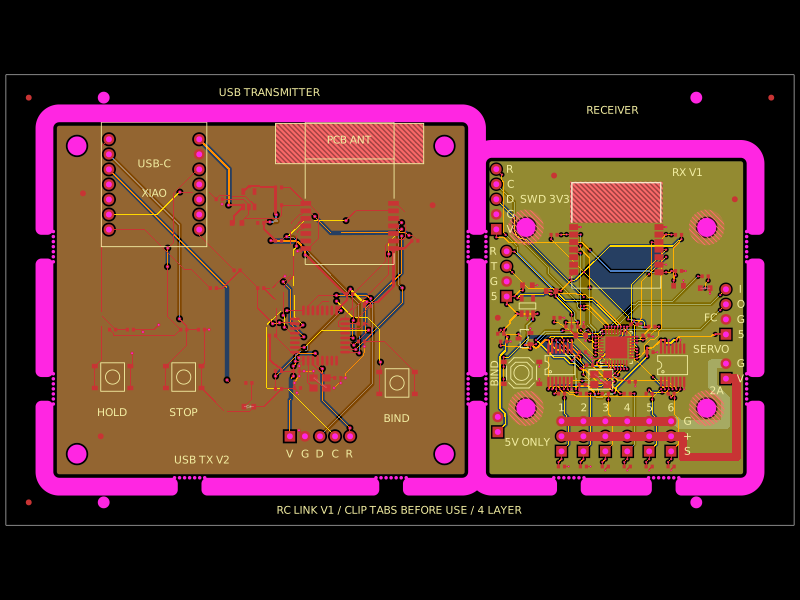 More from this authormohan-bee/rc-link-breakaway-panelA four-layer RC link panel combining an STM32/E28 2.4‑GHz transmitter with USB-RP2040 socket and an STM32/E28 receiver providing six buffered PWM servo outputs, regulated 3.3‑V power, headers, controls, and protection/decoupling.
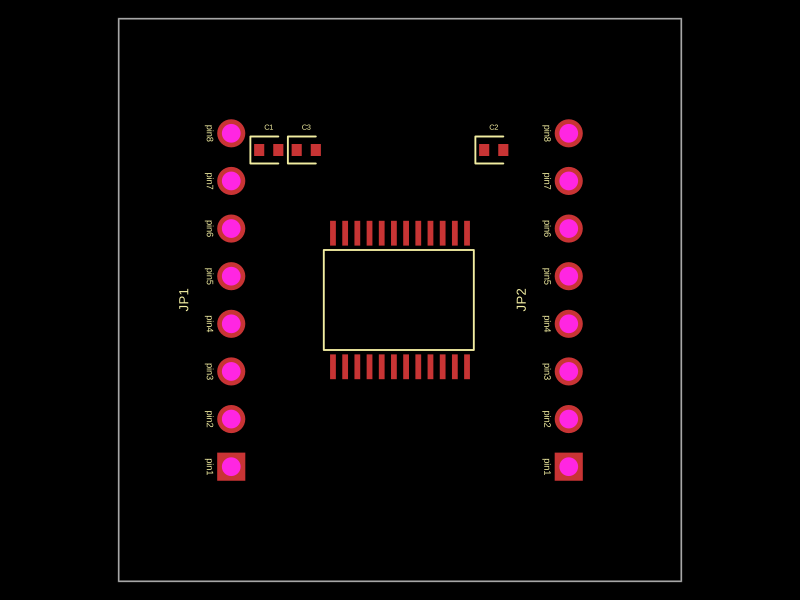 Similar packageimrishabh18/motor-driver-breakout"A 30x30mm TB6612FNG motor driver board with dual 8-pin headers and bypass capacitors for motor control and power regulation"
This summary captures the key physical characteristics:
- Uses TB6612FNG motor driver chip
- 30x30mm board size
- Dual 8-pin headers (JP1 and JP2)
- Includes decoupling capacitors (C1, C2, C3)
- Purpose is motor control and power management
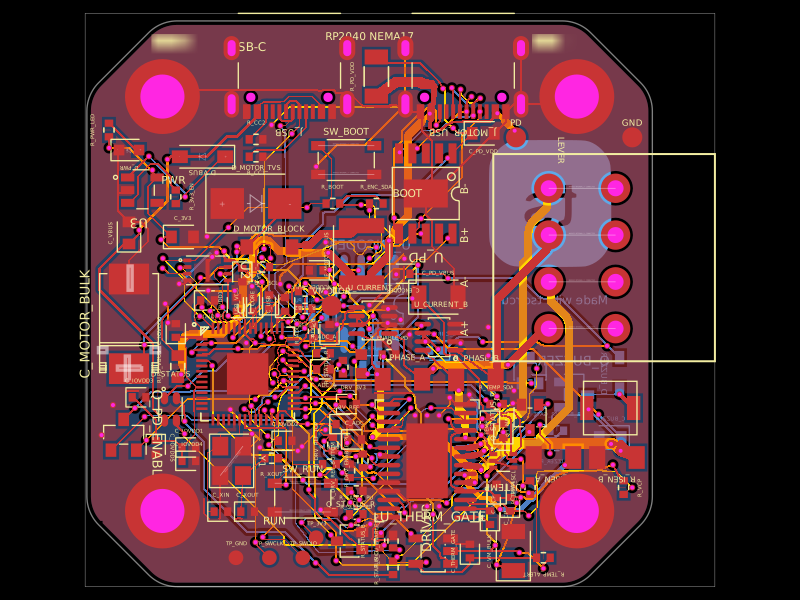 Discover something newastra/nema17-stepper-motor-controller-spring-clamp-rp2040A 4-layer RP2040 controller board that negotiates USB‑C PD motor power and drives a NEMA17 stepper via a DRV8825, with current sensing, thermal shutdown, RGB status LED, buzzer alarm, optional AS5600 encoder, protection/filtering, and test points.