ShiboSoftwareDev/f1c100s-linux-stepper-controller
A four-layer Linux motor-control carrier built around an Allwinner F1C100S SoC, USB‑C, SPI flash, multi-rail power regulation, DRV8825 stepper-driver stage with protection/current sensing, temperature monitoring, and external I/O connectors.
- Version
- 0.1.1
- License
- unset
- Stars
- 0
firmware/motor-control.py
#!/usr/bin/env python3
"""Conservative DRV8825 step/dir control through Linux libgpiod 2.x.

This is an integration and bring-up utility, not a real-time motion planner.
Linux userspace scheduling adds pulse jitter; use a timer/PWM-capable kernel
driver or a dedicated motion coprocessor when precise or high-rate motion is
required. The board is fixed at 1/16 microstepping and about 0.5 A peak/phase.
"""

import argparse
import pathlib
import time


STEP = "PE2"
DIR = "PE3"
ENABLE = "PE4"       # high releases both nSLEEP and nRESET
FAULT = "PE5"        # active low
TEMP_ALERT = "PE6"   # active low


def find_tmp102_input():
    for name_path in pathlib.Path("/sys/class/hwmon").glob("hwmon*/name"):
        try:
            if name_path.read_text().strip() == "tmp102":
                candidate = name_path.parent / "temp1_input"
                if candidate.exists():
                    return candidate
        except OSError:
            pass
    return None


def read_temperature_c(path):
    if path is None:
        return None
    return int(path.read_text().strip()) / 1000.0


def main():
    parser = argparse.ArgumentParser(description=__doc__)
    parser.add_argument("--chip", default="/dev/gpiochip0", help="PIO GPIO chip from gpioinfo")
    parser.add_argument("--steps", type=int, default=3200, help="step pulses; 3200 is one revolution for a 200-step motor")
    parser.add_argument("--hz", type=float, default=200.0, help="step frequency (userspace; keep conservative)")
    parser.add_argument("--direction", choices=("forward", "reverse"), default="forward")
    parser.add_argument("--hold-seconds", type=float, default=0.0, help="hold torque before disabling")
    parser.add_argument("--max-temperature", type=float, default=80.0, help="abort at this TMP102 temperature in degC")
    parser.add_argument("--temp-path", type=pathlib.Path, help="override TMP102 hwmon temp1_input path")
    parser.add_argument("--dry-run", action="store_true", help="validate arguments and print the intended motion")
    args = parser.parse_args()

    if args.steps < 0:
        parser.error("--steps must be nonnegative")
    if not 0.5 <= args.hz <= 2000:
        parser.error("--hz must be between 0.5 and 2000 for this userspace utility")
    if args.hold_seconds < 0:
        parser.error("--hold-seconds must be nonnegative")
    temp_path = args.temp_path or find_tmp102_input()
    if args.dry_run:
        print(f"{args.steps} pulses at {args.hz:g} Hz, direction={args.direction}, "
              f"estimated duration={args.steps / args.hz:.3f} s")
        print(f"TMP102 path: {temp_path or 'not found (GPIO ALERT remains active)'}")
        return

    import gpiod
    from gpiod.line import Direction, Value

    low, high = Value.INACTIVE, Value.ACTIVE
    output = gpiod.LineSettings(direction=Direction.OUTPUT, output_value=low)
    input_line = gpiod.LineSettings(direction=Direction.INPUT)
    config = {(STEP, DIR, ENABLE): output, (FAULT, TEMP_ALERT): input_line}
    half_period = 0.5 / args.hz

    with gpiod.request_lines(args.chip, consumer="f1c100s-drv8825", config=config) as request:
        def shutdown():
            request.set_value(STEP, low)
            request.set_value(ENABLE, low)

        def safety_check():
            if request.get_value(FAULT) == low:
                raise RuntimeError("DRV8825 nFAULT asserted; motor disabled")
            temperature = read_temperature_c(temp_path)
            if request.get_value(TEMP_ALERT) == low:
                raise RuntimeError("TMP102 ALERT asserted; motor disabled")
            if temperature is not None and temperature >= args.max_temperature:
                raise RuntimeError(f"TMP102 temperature {temperature:.1f} degC exceeds limit")

        try:
            shutdown()
            request.set_value(DIR, high if args.direction == "reverse" else low)
            time.sleep(0.001)
            safety_check()
            request.set_value(ENABLE, high)
            time.sleep(0.002)
            for index in range(args.steps):
                if index % 32 == 0:
                    safety_check()
                request.set_value(STEP, high)
                time.sleep(half_period)
                request.set_value(STEP, low)
                time.sleep(half_period)
            if args.hold_seconds:
                deadline = time.monotonic() + args.hold_seconds
                while time.monotonic() < deadline:
                    safety_check()
                    time.sleep(min(0.1, max(0.0, deadline - time.monotonic())))
        finally:
            shutdown()


if __name__ == "__main__":
    main()
Related Packages
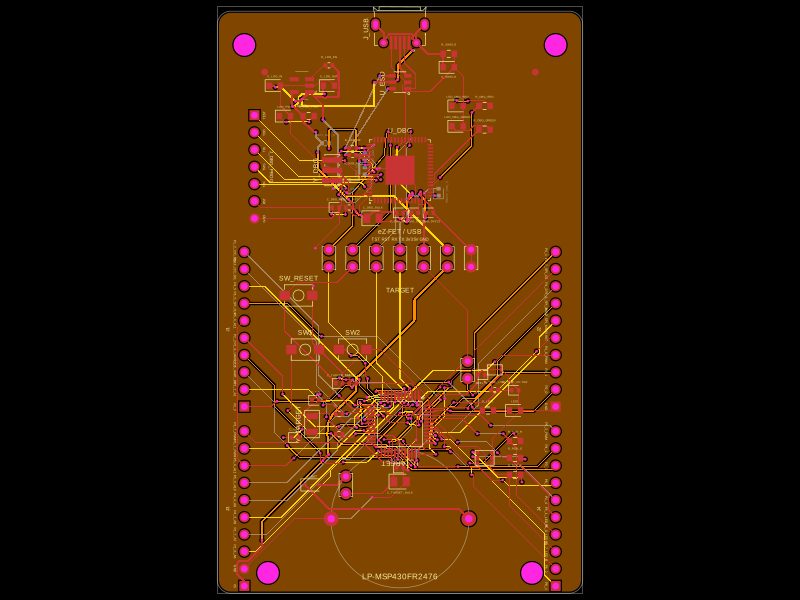 More from this authorShiboSoftwareDev/lp-msp430fr2476This design implements a microcontroller-based development board featuring an MSP430FR2476 target MCU with associated power regulation, USB host interface with ESD protection, multiple headers for peripherals and BoosterPacks, and integrated status LEDs and sensors.
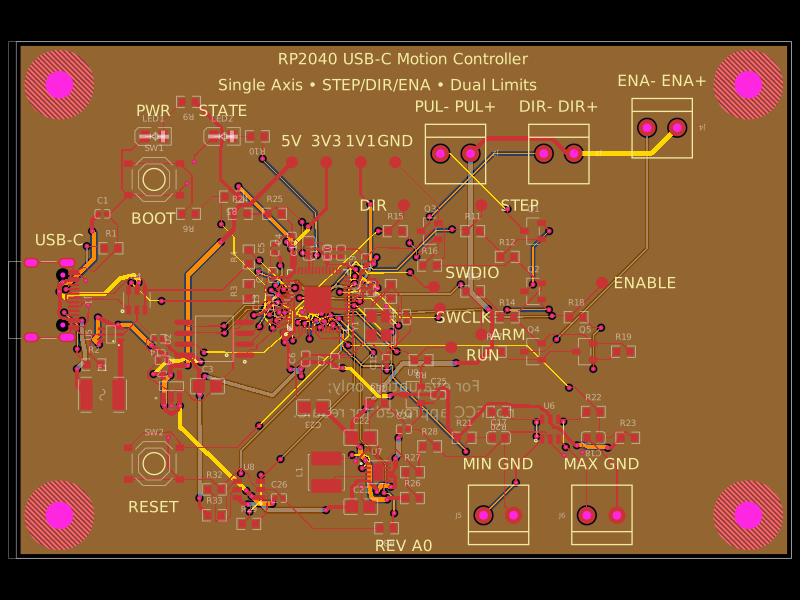 Similar packageAnasSarkiz/rp2040-usb-c-single-axis-dm542t-motion-controller--01a0e89cA USB‑C RP2040 controller board with external QSPI flash, crystal clock, regulated 3.3/1.1/5 V power, boost-converted motor-driver supply, protected USB and limit inputs, status LEDs, reset/boot switches, and AO3400A MOSFET outputs for stepper-control signals.
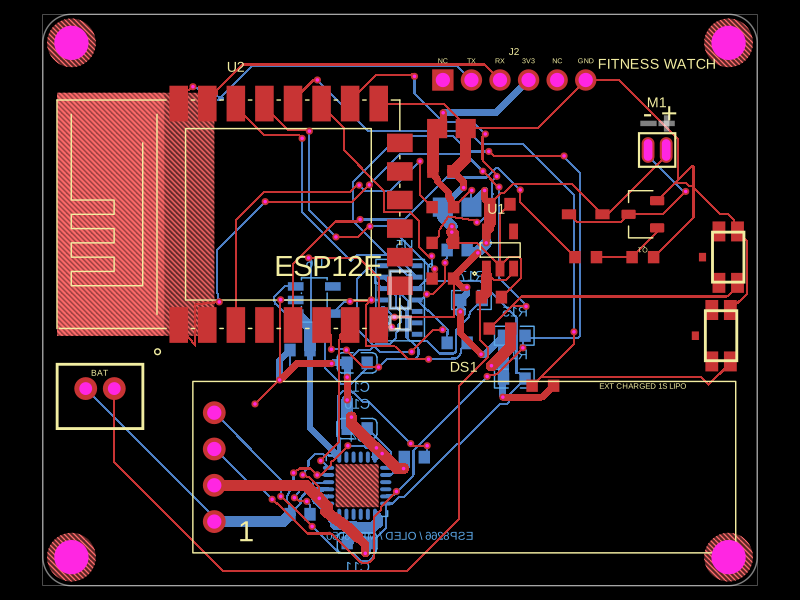 Discover something newimrishabh18/fitness_watchThis circuit integrates an ESP-12E microcontroller with various sensors and peripherals, including a AO3400A MOSFET for switching loads, to enable wireless control and sensor data processing.