seveibar/f1c1990s-dev-board
This code manages the entire PCB assembly process for a computer hardware module, including component placement, schematic integration, automated routing, copper pouring, and design rule checks, focused on a four-layer carrier board with integrated support components and connectors.
- Version
- 1.8.0
- License
- unset
- Stars
- 0
firmware/rgb-demo.py
#!/usr/bin/env python3
"""SK9822-A indicator, using libgpiod 2.x and Linux GPIO character devices.

PE2 = data, PE3 = clock. This exact SK9822-A variant transmits GRB, not
APA102's usual BGR order; see its Rev.01 datasheet, page 6.
"""
import argparse
import time


def frame(red, green, blue, brightness=2):
    if not all(isinstance(x, int) and 0 <= x <= 255 for x in (red, green, blue)):
        raise ValueError("RGB channels must be integers in 0..255")
    if not isinstance(brightness, int) or not 0 <= brightness <= 2:
        raise ValueError("Indicator brightness is limited to 0..2 of 31")
    # Start, one pixel (111 + five brightness bits + G/R/B), end frame.
    # Extra zeros also provide the reset/latch clocks required by SK9822 variants.
    return bytes(4) + bytes([0xE0 | brightness, green, red, blue]) + b'\xff'*4 + bytes(4)


def main():
    p = argparse.ArgumentParser(description=__doc__)
    p.add_argument('--chip', default='/dev/gpiochip0', help='PIO GPIO chip from gpioinfo')
    p.add_argument('--rgb', nargs=3, type=int, default=[255, 0, 0], metavar=('R', 'G', 'B'))
    p.add_argument('--brightness', type=int, choices=range(3), default=2)
    p.add_argument('--seconds', type=float, default=3)
    p.add_argument('--demo', action='store_true', help='cycle red, green, blue and white')
    p.add_argument('--dry-run', action='store_true', help='print frame without using GPIO')
    args = p.parse_args()
    try:
        data = frame(*args.rgb, args.brightness)
    except ValueError as e:
        p.error(str(e))
    if args.seconds < 0:
        p.error('--seconds must be nonnegative')
    if args.dry_run:
        print(data.hex(' '))
        return
    import gpiod
    from gpiod.line import Direction, Value
    low, high = Value.INACTIVE, Value.ACTIVE
    # Names prevent silently targeting different GPIOs if chip numbering changes.
    with gpiod.request_lines(args.chip, consumer='sk9822-indicator', config={
        ('PE2', 'PE3'): gpiod.LineSettings(direction=Direction.OUTPUT, output_value=low)
    }) as req:
        def send(payload):
            for byte in payload:
                for bit in range(7, -1, -1):
                    req.set_value('PE3', low)
                    req.set_value('PE2', high if byte & (1 << bit) else low)
                    time.sleep(0.00001)
                    req.set_value('PE3', high)
                    time.sleep(0.00001)
            req.set_value('PE3', low)
            req.set_value('PE2', low)
        try:
            send(frame(0, 0, 0, 0))
            colors = [(255,0,0),(0,255,0),(0,0,255),(255,255,255)] if args.demo else [args.rgb]
            for color in colors:
                send(frame(*color, args.brightness))
                time.sleep(args.seconds)
        finally:
            send(frame(0, 0, 0, 0))


if __name__ == '__main__':
    main()
Related Packages
 More from this authorseveibar/testpointsThis hardware consists of a small PCB with five test points arranged linearly, interconnected through a 1kΩ resistor and a 1000pF capacitor, forming a simple RC test configuration.
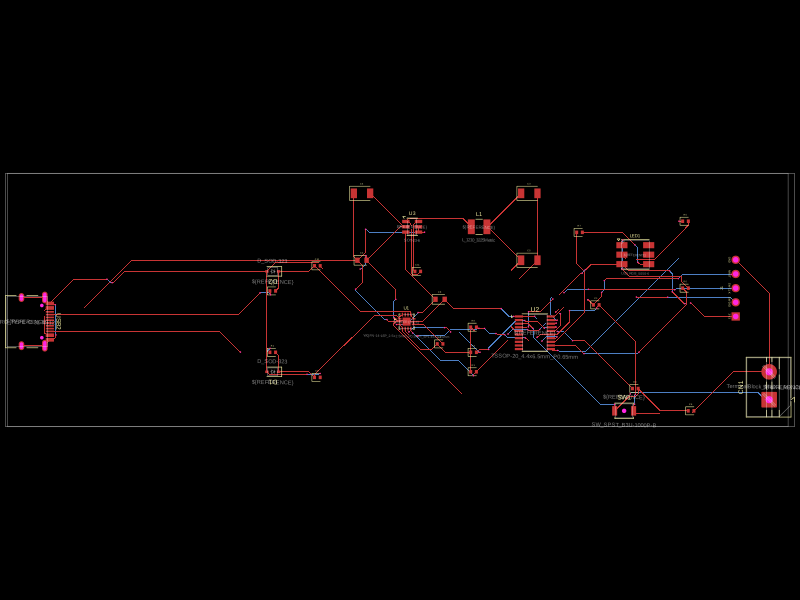 Similar packageaura/diy-power-delivery-triggerThis hardware design implements a USB Type-C port with supporting power management and signal conditioning components, including a USB-C connector, a FUSB302 USB-C port controller, ESD protection diodes, a buck converter for 3.3V power regulation, an STM32 microcontroller for control and processing, an RGB LED indicator, push button, terminal block connections, and associated filtering and support components.
 Discover something newabse/gameboy-advanceThis code defines a collection of hardware components, including microcontrollers, sensors, display modules, power management ICs, and passive/passive components, each modeled as 3D symbols with specific footprints, pin configurations, and associated models for PCB and schematic design.