rushabhcodes/desk-fidget-counter
A desk knob assembly combining a circuit board with PETG-printed mechanical parts and vendor CAD-modeled hardware.
- Version
- 5.6.1
- License
- MIT
- Stars
- 0
README.md
PCB

Schematic

# Desk fidget counter
A USB-powered scroll ring with a fixed **1.28-inch round display**. It counts complete turns, retains the count in FRAM, and shows your computer’s clock, CPU/RAM usage and battery through a USB companion app.
Short-press the front button to switch between scrolling and counting only. Hold for three seconds to clear the count. The screen and cable stay fixed while the outer grip rotates.
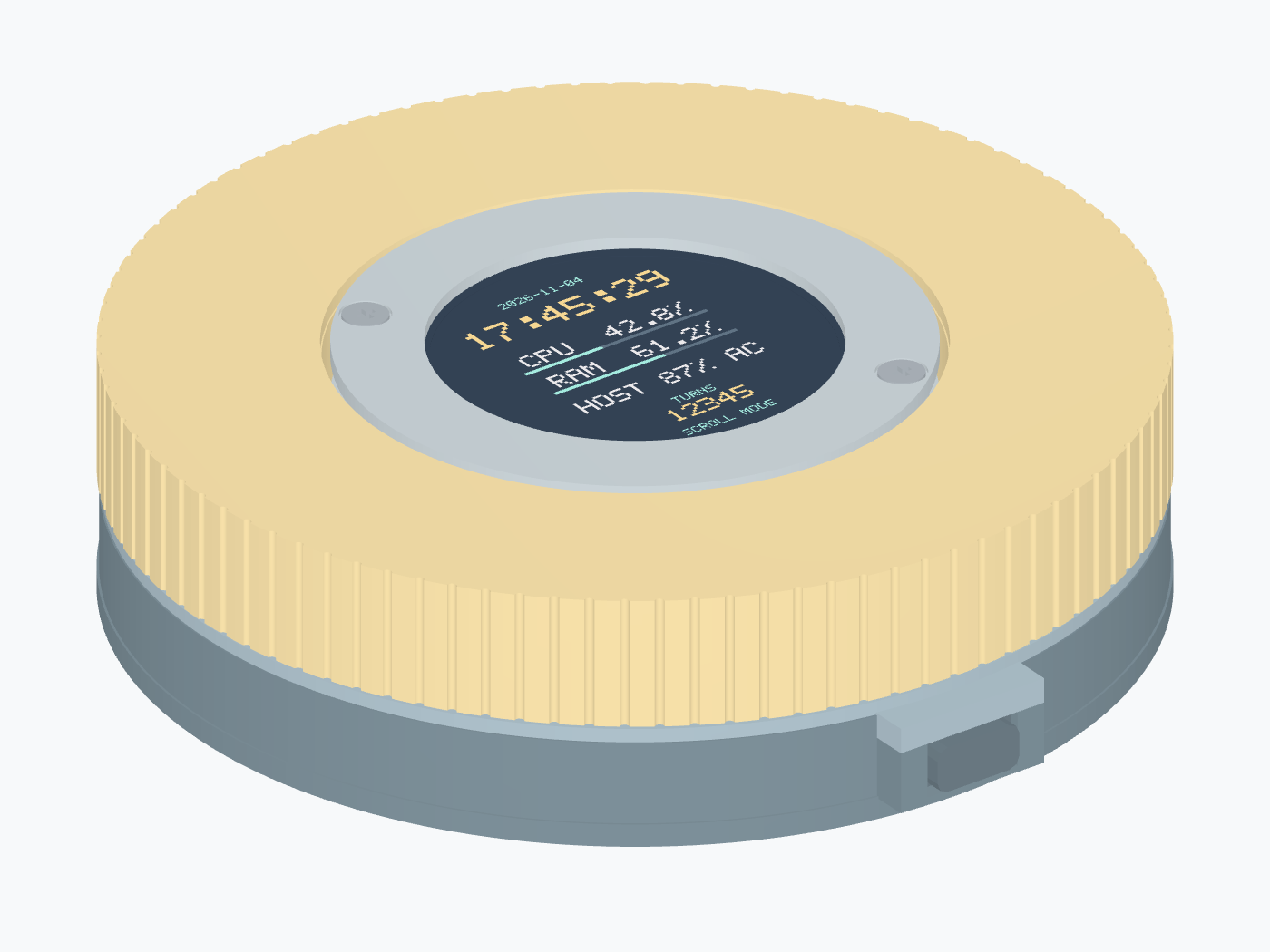
## Board and enclosure
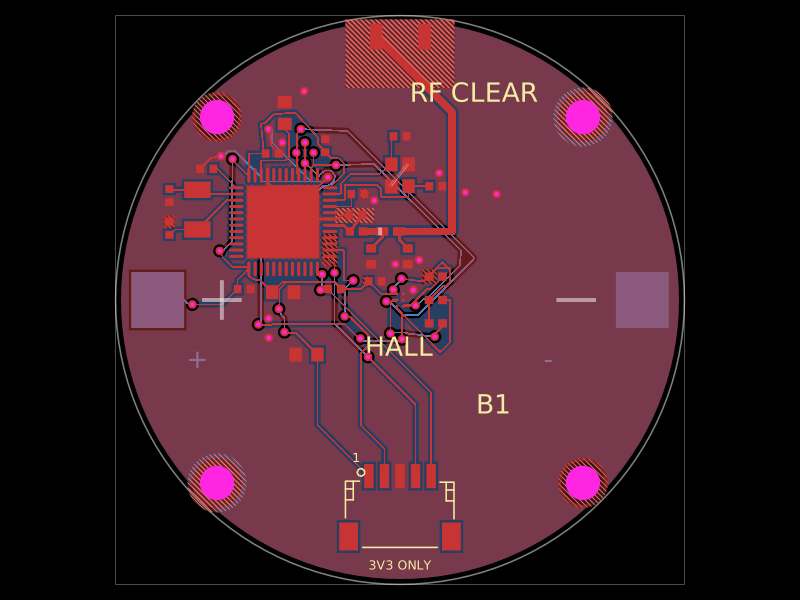
- **Two-layer, 1.6 mm PCB**, with all 38 fitted components on top. USB-C is on the rear; an 8×4 mm captive printed cap operates the front Omron switch.
- **Six product prints and four screws**, in an approximately **Ø84.8 × 22.3 mm** body; the front cap brings overall depth to **88.0 mm**. The optical skirt is integral to the grip; the screen carrier and bezel share two screws.
- **One complete 6712ZZ bearing object** in the CAD viewer, including its races, shields, balls and cage. Calibrate the printed bearing fits with the coupons before printing the enclosure.
- Every trace and via comes from **TSCircuit’s native autorouter**. The source defines connectivity, placement and fabrication rules; it contains no hand-routed paths or saved-route imports.
**Prototype status:** the E5 enclosure retains the checked E3 PCB. **Fabrication is on hold until JLCPCB accepts the original USB shield-slot geometry**, or a replacement is qualified. Printed bearing retention and physical operation still need prototype tests. Check the [validation report](https://github.com/rushabhcodes/desk-fidget-counter/blob/main/validation/REPORT.md) before fabrication. Export fresh files from the revision you intend to order. The obsolete v5.4.0 manufacturing files have an incorrect FRAM footprint and must not be used.
## What to buy outside JLCPCB
Quantities below are for **one complete device**. A complete JLCPCB **assembly** order supplies the PCB and its 38 fitted electronic components, including the MCU, optical sensor, FRAM, USB connector, front button and J4 programming header. A bare-PCB order supplies the board only.
| Qty | Buy or supply separately | Specification and purpose |
|---|---|---|
| 1 kit | [Waveshare 19192 display](https://www.waveshare.com/product/1.28inch-lcd-module.htm) | Non-touch, 1.28-inch, 240×240 GC9A01 module. **The kit includes the PH2.0 8-pin cable.** Retain its display plug, shorten the board ends and solder them at J6. |
| 1 | [Complete 6712ZZ bearing](https://maysmeprecision.com/Show/?Cid=677) | **60 mm bore × 75 mm OD × 7 mm**, double metal shields. Buy the assembled bearing; its internal balls/races are not separate purchases. |
| 6 | [E5 printed enclosure parts](https://github.com/rushabhcodes/desk-fidget-counter/tree/main/mechanical/stl) | `base`, `lid`, `knob`, `screen-carrier`, `screen-bezel`, `button-cap`. PETG; the grip’s integral optical track must be **opaque at 950 nm**. Black colour alone does not establish this. Print the fit coupons first. |
| 2 | Countersunk **DIN 965 M2×6** screws | Attach the base and lid. Nominal head Ø3.8 mm; check the actual purchased head/drive against the model. |
| 2 | Countersunk **DIN 965 M2×10** screws | One shared pair retains the screen bezel and carrier on the base posts. |
| 1 small piece | [PORON 4701-30-20062-04 foam](https://www.rogerscorp.com/elastomeric-material-solutions/poron-industrial-polyurethanes/poron-4701-30) | **1.57 mm** nominal, 320 kg/m³. Cut four Ø4 mm and two Ø2.6 mm PCB capture pads; a 20×20 mm sample is sufficient. |
| 1 small piece | [3M 467MP transfer adhesive](https://www.3m.com/3M/en_US/p/dc/v000185218/) | **0.05 mm** adhesive for the six foam pads. The integral optical skirt needs no separate adhesive joint. |
| As needed | [3M 5413 polyimide tape](https://www.3m.co.uk/3M/en_GB/p/d/v000091659/) | **0.069 mm** insulation over inspected underside solder wells. Trim through-hole tails/joints to the documented ≤0.8 mm allowance first. |
| 1, reuse if suitable | USB data cable | USB-C at the device; ordinary USB 2.0 data is sufficient. Check the plug against the enclosure’s documented 13.4×6.9 mm approach gauge. |
| Optional: 3 | Adhesive silicone feet | Approximately Ø5×1 mm. These add 1 mm to the nominal body height. |
**No additional display cable, adapter or J6 header is required. J6 is DNP.** The display, bearing, printed parts and final wiring/mechanical assembly are not supplied as part of PCB assembly.
### Programming equipment and tools
These items are reusable and removed before closing the enclosure:
| Qty | Item | Requirement |
|---|---|---|
| 1 | SWD programmer | ST-LINK/V2 or a compatible STM32 SWD probe. USB powers the board; VTref is a sense connection. |
| 1 | J4 programming lead | JST **PHR-6**, 2.0 mm PH series, with the correct probe-end termination. A precrimped lead can be used. If making it, use five **SPH-004T-P0.5S** contacts plus spares and qualified 32–28 AWG wire, insulation Ø0.5–0.9 mm. See the [physical pin map](https://github.com/rushabhcodes/desk-fidget-counter/blob/main/manufacturing/WIRING.md). |
| Only for SMT-only PCBA | J4 board header | If you order the **37-placement SMT-only** option, buy and hand-solder **JST B6B-PH-K-S(LF)(SN), C131342**. The complete 38-placement assembly includes it. |
Have solder/flux and a soldering setup, wire stripper, flush cutters, multimeter, caliper, an M2×0.4 tap and a screwdriver matching your screws. Follow the [printing and fit guide](https://github.com/rushabhcodes/desk-fidget-counter/blob/main/mechanical/FIT.md); the supplied print orientations and support notes matter.
## Software and controls
Flash the firmware through J4, then initialize a fresh FRAM with a three-second button hold or the explicit console command in the [firmware guide](https://github.com/rushabhcodes/desk-fidget-counter/blob/main/firmware/README.md).
For laptop information:
```sh
python -m pip install -r companion/requirements.txt
python companion/dashboard.py
```
The [companion guide](https://github.com/rushabhcodes/desk-fidget-counter/blob/main/companion/README.md) covers macOS, Windows and Linux. Counting and scrolling work without the companion while USB is awake. USB suspend switches the display and encoder off; turns during suspend are not measured.
## Build and validation
```sh
bun install --frozen-lockfile
bun run typecheck && bun run test
bun run check:netlist && bun run check:schematic
bun run build
bun run check:placement && bun validation/check-design.mjs
bun run check:footprints && bun run check:shorts && bun run check:assembly
```
`assembly.circuit.tsx` is the complete product; `index.circuit.tsx` is the bare PCB. The build stages the checked full assembly at `dist/circuit.json` for publication. Source, package CAD, prints and wiring are included in the repository. You will export/download the fabrication files and place the order; no new fabrication kit is prepared.
- [Assembly steps](https://github.com/rushabhcodes/desk-fidget-counter/blob/main/ASSEMBLY.md) · [Wiring and programming connections](https://github.com/rushabhcodes/desk-fidget-counter/blob/main/manufacturing/WIRING.md)
- [Mechanical source and CAD](https://github.com/rushabhcodes/desk-fidget-counter/blob/main/mechanical/README.md) · [Model provenance and limitations](https://github.com/rushabhcodes/desk-fidget-counter/blob/main/mechanical/vendor/README.md)
- [Manufacturing requirements](https://github.com/rushabhcodes/desk-fidget-counter/blob/main/manufacturing/README.md) · [Validation results](https://github.com/rushabhcodes/desk-fidget-counter/blob/main/validation/REPORT.md) · [First-prototype bring-up](https://github.com/rushabhcodes/desk-fidget-counter/blob/main/validation/BRINGUP.md)
Inspired by the [Ploopy Knob](https://ploopy.co/knob/) and [original fidget counter](https://tscircuit.com/rushabhcodes/fidget-counter). Project code and original geometry are MIT; purchased-part assets retain their upstream rights.
Related Packages
 More from this authorrushabhcodes/fidget-counter
 Discover something newDevesh36/orbit-turntableORBIT is a USB-C-powered display turntable for photographing jewellery, models and small products. Four-layer ESP32-C3 / ULN2003 PCB, geared stepper, OLED, push encoder, home switch and buzzer, with an enclosed and exploded assembly. Hardware prototype; firmware and physical qualification remain separate.