imrishabh18/rp2040-motor-controller
An RP2040-based NEMA17 stepper-motor controller with USB-C programming and PD motor-power negotiation, DRV8825 dual H-bridge drive, current/temperature telemetry, protected power filtering, status RGB LED, buzzer alarm, and optional magnetic encoder.
- Version
- 1.0.42
- License
- unset
- Stars
- 3
engineering/outer-layer-power-routing.md
# Outer-layer motor power routing — v1.0.35

The requested routing policy keeps the motor USB-PD supply, fused supply, protected motor rail, both winding paths (including both sides of the inline measurement shunts), and DRV8825 regulation-shunt connections on top/bottom copper. Through-hole vias may join top and bottom; no lateral current-carrying track on these motor nets uses inner1/inner2. Low-current logic routing and grounded inner copper for heat spreading remain.

The longer motor-supply runs use 0.6 mm copper (0.8 mm at the main PD feed), and winding runs use 0.55 mm with short pad escapes. The VMA pin retains a 0.69 mm-long, 0.15 mm diagonal neck forced by adjacent AOUT1 copper; its adjoining segments are widened to 0.5 and 0.2 mm. This is a local package escape, not the width of the supply run. Final thermal suitability still needs a powered prototype test.

The source circuit, component population and placements are unchanged from v1.0.34. Low-current signals were rerouted around the wider motor paths. Some branches join a different terminal of the same electrical net, including the TMP102 bypass-supply and I²C branches; the source netlist is unchanged. Separate Kelvin branches remain at the current-sense shunts. The existing 5–20 V GPIO-configurable CH224K and I²C-only temperature interface are retained. Application firmware is not included.

A regression reconstructs the eleven motor power nets from source connectivity and rejects inner-layer wire segments. Three ground links were rerouted to top/bottom to connect regions that previously depended on an inner-layer route. Physical ground connectivity is also checked using only top/bottom copper and plated barrels. Layer membership is checked in the built circuit, and the usual Gerber shorts, geometry, Kelvin and thermal-via audits cover the exported result.

See [current validation](revision-checks.json) for completed checks and their scope. Copper geometry checks do not replace a prototype temperature/ripple/current test. Nothing is published by this local revision.

The 0.10 mm hard copper-clearance rule is unchanged. Moving the power tracks outside creates additional sites below the preferred 0.15 mm power-to-pad spacing. [The reviewed exceptions](power-pad-clearance-review.json) record each pad/trace pair and its minimum accepted gap. The regression rejects new exceptions and smaller gaps instead of reusing the previous layout’s aggregate count limit.
Related Packages
 More from this authorimrishabh18/3d-model-testIt loads a 3D model of an electronic component onto a circuit board with specified positioning.
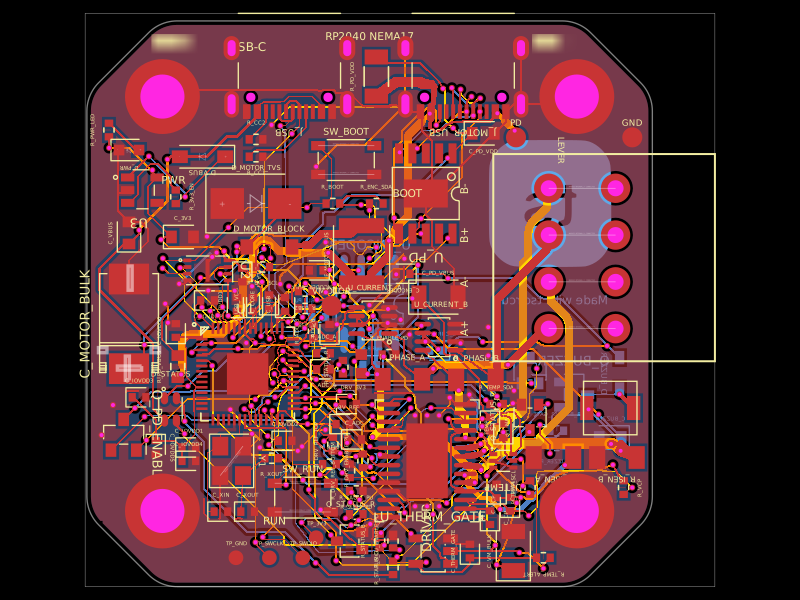 Similar packageastra/nema17-stepper-motor-controller-spring-clamp-rp2040A 4-layer RP2040 controller board that negotiates USB‑C PD motor power and drives a NEMA17 stepper via a DRV8825, with current sensing, thermal shutdown, RGB status LED, buzzer alarm, optional AS5600 encoder, protection/filtering, and test points.
 Discover something newseveibar/am3352-dev-board-4layer-dogboneDefines PCB footprints and pin mappings for a TI AM3352ZCZ100 processor, JST GH connectors, and assembly-part lookup helpers for capacitors, resistors, and headers.