gokul/lora-device
A compact LoRa/GNSS device PCB integrating an SX1262 radio, GNSS module, USB/UART interface, 1.5 µH inductor, LiPo battery connector with NTC, and supporting passives.
- Version
- 0.1.6
- License
- unset
- Stars
- 0
docs/firmware-interface.md
# Firmware interface

| Function | ESP32-S3 GPIO | Behavior |
| --- | ---: | --- |
| LoRa NSS | 10 | SPI chip select, active low |
| LoRa MOSI | 11 | SPI controller output |
| LoRa SCK | 12 | SPI clock |
| LoRa MISO | 13 | SPI controller input |
| LoRa BUSY | 4 | Input; wait before issuing commands |
| LoRa DIO1 | 5 | Radio interrupt |
| LoRa reset | 6 | Active low |
| GNSS power | 7 | High enables the switched GNSS rail |
| GNSS UART RX | 15 | Receives SAM-M10Q TX through U8 |
| GNSS UART TX | 16 | Drives SAM-M10Q RX through U8 |
| USER button | 17 | Active low, external 10 kΩ pull-up |
| LINK LED | 48 | High turns blue LED on |
| Charger input limit | 21 | High = 500 mA; low = 100 mA (EN2 fixed low) |
| USB power-good | 47 | Active-low charger PGOOD, external pull-up |
| Battery sense | 1 | 1 MΩ / 1 MΩ divider; nominal VBAT = 2 × ADC voltage |
| Native USB D− / D+ | 19 / 20 | USB programming and serial |
| BOOT | 0 | Active low |
| Debug UART TX / RX | 43 / 44 | TP1 / TP2; TP3 is GND |

Use the ESP32-S3 target with 8 MB flash and no PSRAM. Set the radio's RF-switch control to DIO2 and its TCXO control to DIO3 according to the Wio-SX1262 module documentation; the module uses the SX1262 DC-DC configuration. Its external RF_SW and ANT pads are unused on this IPEX design.

The intended radio band is 865–867 MHz. Select the appropriate India-region settings in the chosen protocol stack and use a matching antenna. A compatible receiving node or gateway is necessary to receive location packets.

Bring-up order: measure 3.3 V with current-limited power, verify USB enumeration and programming, test buttons/LEDs, enable GNSS and confirm UART output outdoors, then test the radio at low transmit power with an antenna attached. Check charger current and thermistor behavior with the intended battery pack. GNSS acquisition, radio range, EMC and thermal performance require hardware measurement.
Related Packages
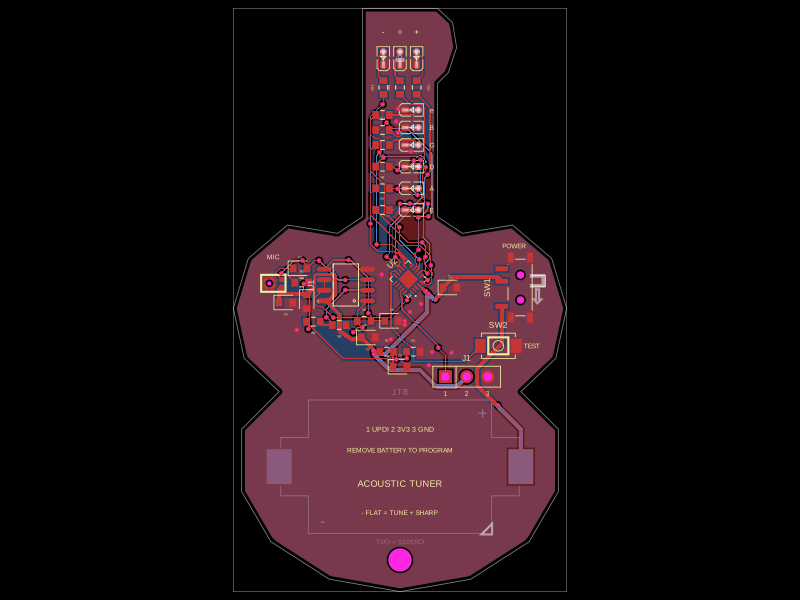 More from this authorgokul/acoustic-guitar-tunerThis code defines the physical pin configuration and footprint layouts for the ATtiny1616 microcontroller and a matching tactile switch component, including their key hardware connection points, dimensions, and 3D models.
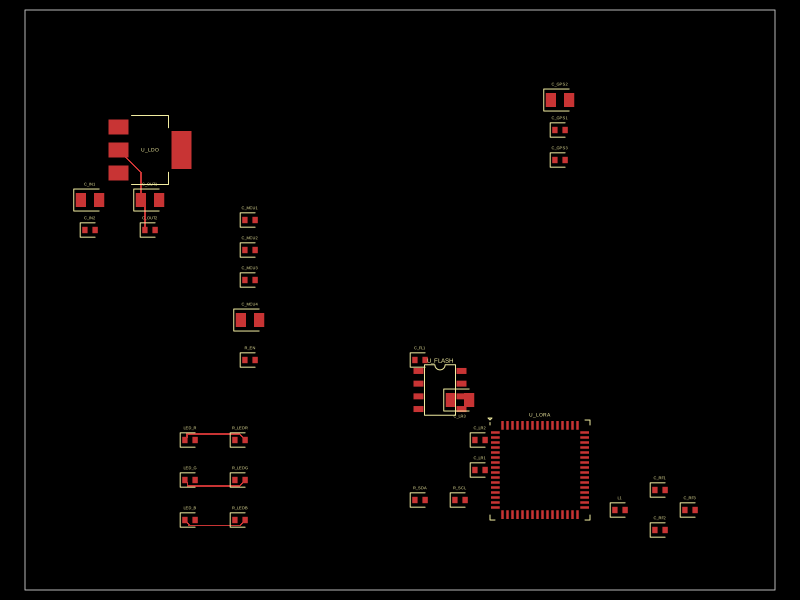 Similar packagecodezonly/pt1This design implements a compact embedded hardware module combining a Seeed XIAO ESP32-C6 microcontroller, a RushFPV GNSS Mini M10 GPS module, and an SX1262 LoRa transceiver, integrated with USB-C power/data, user interface LEDs and buttons, decoupling capacitors, and antenna connectors for GPS and LoRa communication.
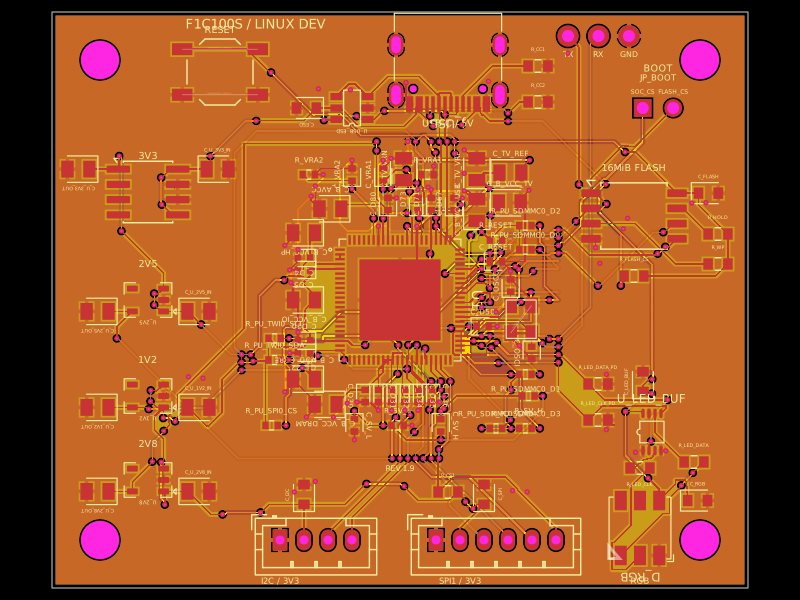 Discover something newseveibar/f1c100s-linux-dev-boardA 4-layer F1C100S Linux development carrier board with USB‑C power/data, multi-rail LDOs, SPI NOR flash, reset/boot interfaces, I²C/SPI/UART headers, ESD protection, and a buffered 5‑V clocked RGB LED.