gokul/acoustic-guitar-tuner
This code defines the physical pin configuration and footprint layouts for the ATtiny1616 microcontroller and a matching tactile switch component, including their key hardware connection points, dimensions, and 3D models.
- Version
- 1.0.10
- License
- unset
- Stars
- 1
firmware/acoustic_tuner_attiny1616/pitch_detector.h
#pragma once
#include <stdint.h>
#include <math.h>

namespace tuner {
constexpr uint16_t sampleCount = 256;
constexpr uint16_t sampleRate = 8000;
constexpr uint16_t firstLag = 21;
constexpr uint16_t lastLag = 119;

// Input is signed, mean-removed, 10-bit ADC data. Fixed bounds keep SRAM use
// predictable on the ATtiny1616. Scores use the same normalization for peak
// selection and interpolation, unlike the earlier raw-correlation interpolator.
inline float estimate(const int16_t* samples) {
  int32_t energy = 0;
  for (uint16_t i = 0; i < sampleCount; ++i)
    energy += (int32_t)samples[i] * samples[i];
  if (energy < 1024) return 0;

  float score[lastLag + 1] = {};
  float strongest = 0;
  for (uint16_t lag = firstLag; lag <= lastLag; ++lag) {
    int32_t cross = 0, a2 = 0, b2 = 0;
    for (uint16_t i = 0; i < sampleCount - lag; ++i) {
      const int16_t a = samples[i], b = samples[i + lag];
      cross += (int32_t)a * b;
      a2 += (int32_t)a * a;
      b2 += (int32_t)b * b;
    }
    score[lag] = a2 + b2 ? (2.0f * cross) / (a2 + b2) : 0;
    if (score[lag] > strongest) strongest = score[lag];
  }
  if (strongest < 0.8f) return 0;

  // Pick the earliest strong local peak, avoiding 2x/3x-period octave errors.
  for (uint16_t lag = firstLag + 1; lag < lastLag; ++lag) {
    const float left = score[lag - 1], mid = score[lag], right = score[lag + 1];
    if (mid < 0.93f * strongest || mid <= left || mid < right) continue;
    const float curvature = left - 2 * mid + right;
    float offset = fabsf(curvature) > 0.000001f ? 0.5f * (left - right) / curvature : 0;
    if (offset > 0.5f) offset = 0.5f;
    if (offset < -0.5f) offset = -0.5f;
    const float hz = sampleRate / (lag + offset);
    return hz >= 70 && hz <= 360 ? hz : 0;
  }
  return 0;
}
}
Related Packages
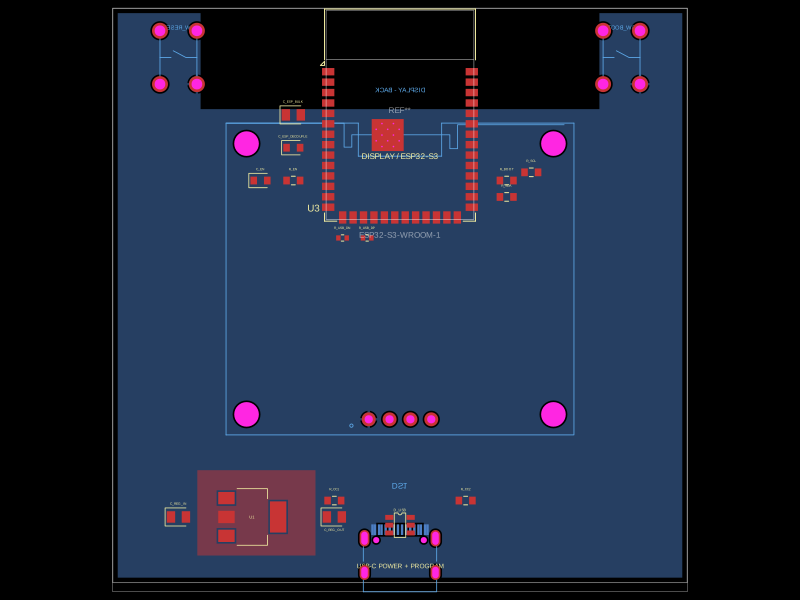 More from this authorgokul/board-v2This design integrates an ESP32-S3 Wi-Fi and Bluetooth module, a USB-C port with power and data circuitry, a USB ESD protection chip, a 3.3V voltage regulator, and an OLED display module on a PCB with associated routing and thermal copper pour layers.
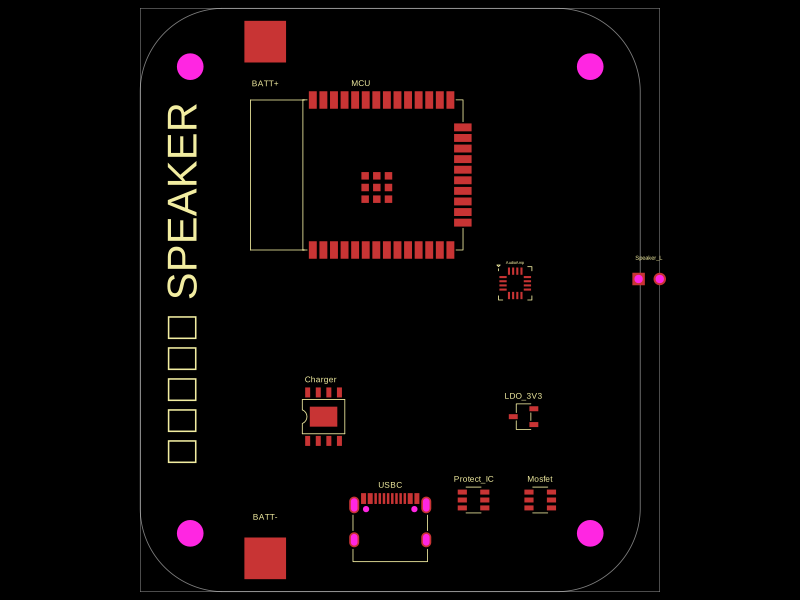 Similar packagemohan-bee/speakerThis code defines configurable 3D models and PCB footprints for various electronic components, including a battery charger IC, a dual Hall sensor, a dual power switch, and a voltage regulator, with detailed pinouts, footprints, and CAD models for schematic and physical design.
 Discover something newrushabhcodes/ESP32-E-ReaderThis code defines the physical layout and schematic wiring of an ESP32-based e-reader device, including various surface-mount components such as connectors, ICs, resistors, capacitors, inductors, diodes, pushbuttons, and an antenna, with precise PCB placement and interconnection details.