ShiboSoftwareDev/clip-on-battery-meter-2
The code defines virtual representations of various electronic components—such as a BAT54WS Schottky diode and LM339 and LM393 voltage comparators—with physical pin configurations, footprints, and 3D models for PCB design.
- Version
- 1.0.13
- License
- unset
- Stars
- 0
TSCIRCUIT_FEEDBACK_1ST_PASS.md
# TSCircuit Feedback While Building `clip-on-battery-meter-2`

- The JLC import flow is useful for footprint generation, but imported pin labels were incomplete for `LMV339IDR` and `LM393DR2G`. Analog IC imports need more reliable pin-name extraction because bad pin metadata is easy to miss and directly affects circuit correctness.
- `tsci search` is strong for electrical parts but weak for mechanical intent. Searches like `battery clip` and `9V battery` returned broad battery-holder or unrelated power-management parts instead of something clearly usable for a clip-on meter workflow.
- The repo bootstrap was a bare resistor-capacitor stub. A better `tsci init` starter for analog indicator projects would help, especially examples with references, comparators, LED bars, and custom connectors.
- The lack of immediate package semantics for imported switches is another rough edge. Physical footprint import is there, but functional pin grouping for 4-pin tactile switches still requires external verification.
- One imported footprint (`LMV331IDBVR`) came in with a numerically tiny-but-invalid pad coordinate (`-1.1368683772161603e-13mm`) that broke PCB parsing until corrected to `0mm`. The importer should normalize near-zero geometry values.
- Imported analog parts also lacked `pinAttributes` for power and ground, which produced avoidable build warnings. That metadata should ideally be inferred or added during import for common IC categories.
- Fixed-position parts inside lightweight grouping constructs were harder to reason about than expected during PCB iteration. It would help if `tscircuit` made it more obvious when grouping affects final placement or source-group behavior.
- The build checker still reported missing `requires_power` / `requires_ground` semantics for imported custom chips even after pin-attribute metadata was added in the generated component files. That looks like a gap between the documented `pinAttributes` model and what the downstream checker actually consumes.
- Autorouting behavior was sensitive to small, seemingly safe geometry changes. One placement variant built quickly with a single DRC hotspot, while another nearby variant produced a much larger cluster of via/trace conflicts and much longer build times. Better route diagnostics or deterministic trace planning controls would make iteration faster.
Related Packages
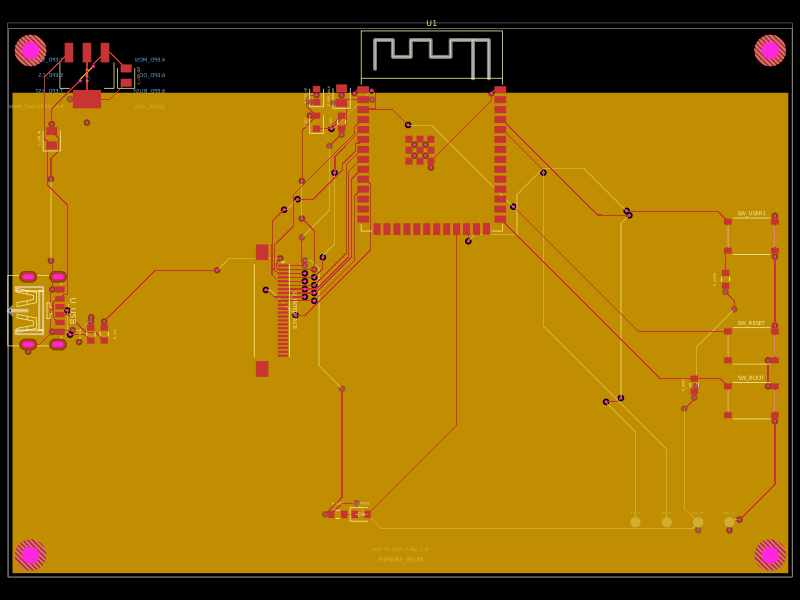 More from this authorShiboSoftwareDev/muse-reterminal-e1001-replacementA four-layer ESP32-S3 e-paper carrier board with USB-C power, AMS1117 3.3V regulation, 24-pin FFC interface, reset/boot and user buttons, status LED, decoupling passives, test points, mounting holes, and ground/power planes.
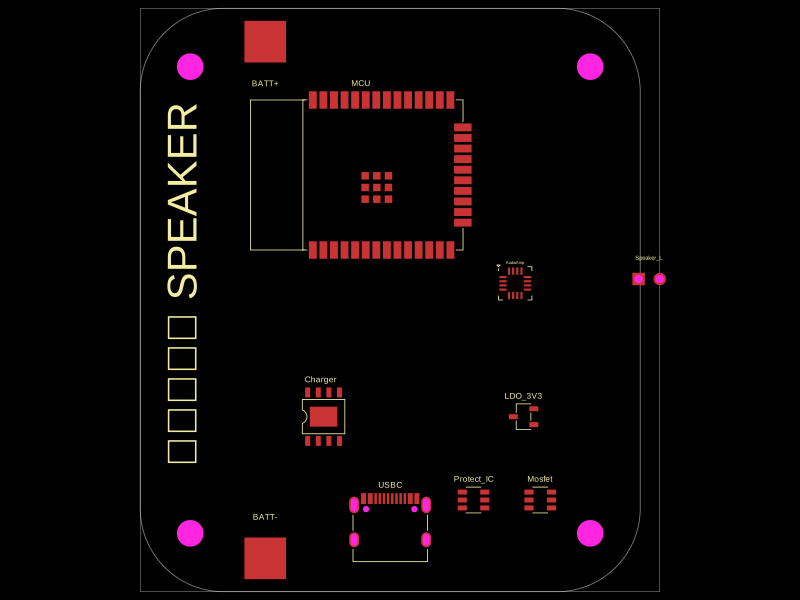 Similar packagemohan-bee/speakerThis code defines configurable 3D models and PCB footprints for various electronic components, including a battery charger IC, a dual Hall sensor, a dual power switch, and a voltage regulator, with detailed pinouts, footprints, and CAD models for schematic and physical design.
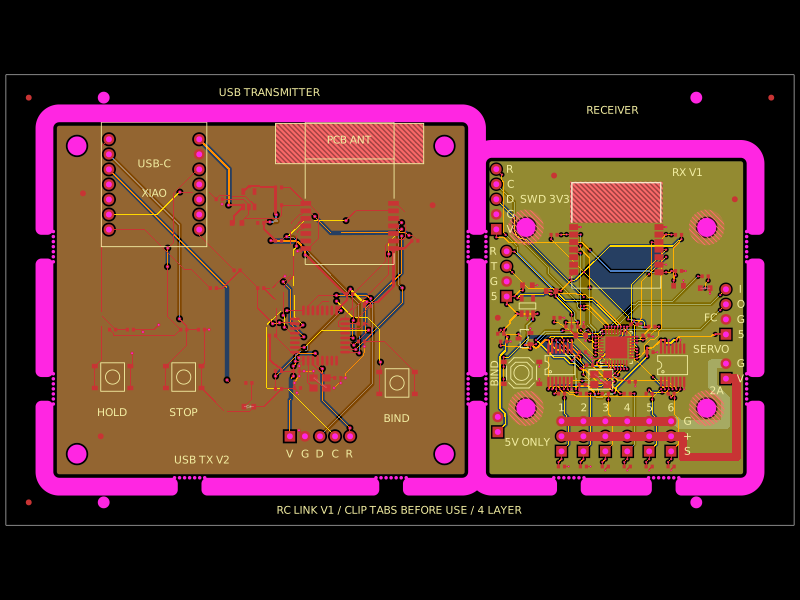 Discover something newmohan-bee/rc-link-breakaway-panelA four-layer RC link panel combining an STM32/E28 2.4‑GHz transmitter with USB-RP2040 socket and an STM32/E28 receiver providing six buffered PWM servo outputs, regulated 3.3‑V power, headers, controls, and protection/decoupling.