AnasSarkiz/rp2040-usb-c-single-axis-dm542t-motion-controller--01a0e89c
A USB‑C RP2040 controller board with external QSPI flash, crystal clock, regulated 3.3/1.1/5 V power, boost-converted motor-driver supply, protected USB and limit inputs, status LEDs, reset/boot switches, and AO3400A MOSFET outputs for stepper-control signals.
- Version
- 0.1.0-prototype.19
- License
- unset
- Stars
- 0
firmware/main.c
#include <inttypes.h>
#include <stdio.h>
#include <string.h>
#include "pico/stdlib.h"
#include "hardware/adc.h"
#include "hardware/clocks.h"
#include "hardware/pio.h"
#include "hardware/sync.h"
#include "hardware/watchdog.h"
#include "motion.h"
#include "step.pio.h"
#include "tusb.h"
#include "usb_sleep.h"
#include "power_policy.h"

#define STEP_PIN 0
#define DIR_PIN 1
#define ENABLE_PIN 2
#define ARM_PIN 3
#define MIN_PIN 4
#define MAX_PIN 5
#define LED_PIN 25
#define SENSE_PIN 26
#define DRIVER_POWER_PIN 6
#define DRIVER_REG_ENABLE_PIN 7
#define DRIVER_FAULT_PIN 8
static PowerPolicy power;
static Motion motion;
static volatile bool host_connected;
static volatile bool supply_ok;
static PIO step_pio=pio0;
static uint step_sm;
static uint64_t previous_tick;
static void usb_abort(const char *reason) {
    uint32_t irq=save_and_disable_interrupts();
    gpio_put(ARM_PIN,0);
    motion_abort(&motion,reason);
    host_connected=false;
    gpio_put(ENABLE_PIN,0);
    restore_interrupts(irq);
}
void tud_suspend_cb(bool remote_wakeup_enabled) {
    (void)remote_wakeup_enabled;
    usb_abort("usb_suspend");
    gpio_put(DRIVER_REG_ENABLE_PIN,0);
    gpio_put(DRIVER_POWER_PIN,0);
    power=(PowerPolicy){.fault_latched=power.fault_latched};
}
void tud_umount_cb(void) {
    usb_abort("usb_reset");
    gpio_put(DRIVER_REG_ENABLE_PIN,0);
    gpio_put(DRIVER_POWER_PIN,0);
    power=(PowerPolicy){0};
}
void tud_cdc_line_state_cb(uint8_t interface, bool dtr, bool rts) {
    (void)rts;
    if (interface==0 && !dtr) usb_abort("serial_closed");
}
static bool tick(struct repeating_timer *timer) {
    (void)timer;
    uint64_t now=time_us_64();
    if (previous_tick && (now-previous_tick<90 || now-previous_tick>150)) motion_abort(&motion,"timer_overrun");
    previous_tick=now;
    // FIFO must be empty before another pulse is counted/queued.
    if (!pio_sm_is_tx_fifo_empty(step_pio,step_sm)) motion_abort(&motion,"pulse_engine_busy");
    motion_tick(&motion,(MotionInputs){host_connected,supply_ok,gpio_get(MIN_PIN),gpio_get(MAX_PIN)});
    if (motion.enabled && motion.enable_ticks>=2000) gpio_put(DIR_PIN,motion.direction>0);
    gpio_put(ENABLE_PIN,motion.enabled);
    gpio_put(ARM_PIN,motion.enabled);
    gpio_put(LED_PIN,motion.enabled);
    if (motion.pulse) pio_sm_put(step_pio,step_sm,0);
    return true;
}
static void print_status(Motion snapshot) {
    printf("STATUS position=%" PRId64 " enabled=%d homed=%d mode=%d min=%d max=%d supply_ok=%d fault=%s\n",snapshot.position,snapshot.enabled,snapshot.homed,snapshot.mode,snapshot.inputs.minimum,snapshot.inputs.maximum,snapshot.inputs.supply_ok,snapshot.fault);
}
int main(void) {
    for (uint pin=0;pin<=3;pin++) { gpio_init(pin); gpio_put(pin,0); gpio_set_dir(pin,GPIO_OUT); }
    gpio_init(DRIVER_POWER_PIN); gpio_put(DRIVER_POWER_PIN,0); gpio_set_dir(DRIVER_POWER_PIN,GPIO_OUT);
    gpio_init(DRIVER_REG_ENABLE_PIN); gpio_put(DRIVER_REG_ENABLE_PIN,0); gpio_set_dir(DRIVER_REG_ENABLE_PIN,GPIO_OUT);
    gpio_init(DRIVER_FAULT_PIN); gpio_set_dir(DRIVER_FAULT_PIN,GPIO_IN);
    gpio_init(LED_PIN); gpio_set_dir(LED_PIN,GPIO_OUT);
    gpio_init(MIN_PIN); gpio_set_dir(MIN_PIN,GPIO_IN); gpio_set_input_hysteresis_enabled(MIN_PIN,true);
    gpio_init(MAX_PIN); gpio_set_dir(MAX_PIN,GPIO_IN); gpio_set_input_hysteresis_enabled(MAX_PIN,true);
    set_sys_clock_48mhz();
    stdio_init_all();
    adc_init(); adc_gpio_init(SENSE_PIN); adc_select_input(0);
    motion_init(&motion);
    step_sm=pio_claim_unused_sm(step_pio,true);
    uint offset=pio_add_program(step_pio,&step_pulse_program);
    pio_sm_config config=step_pulse_program_get_default_config(offset);
    sm_config_set_set_pins(&config,STEP_PIN,1);
    sm_config_set_clkdiv(&config,48.0f); // 48 MHz / 48: exactly 1 us per PIO cycle.
    pio_gpio_init(step_pio,STEP_PIN);
    pio_sm_set_consecutive_pindirs(step_pio,step_sm,STEP_PIN,1,true);
    pio_sm_init(step_pio,step_sm,offset,&config);
    pio_sm_set_pins_with_mask(step_pio,step_sm,0,1u<<STEP_PIN);
    pio_sm_set_enabled(step_pio,step_sm,true);
    struct repeating_timer timer;
    if (!add_repeating_timer_us(-100,tick,NULL,&timer)) panic("motion timer unavailable");
    watchdog_enable(250,true);
    char line[80]; size_t length=0; bool overflow=false;
    while (true) {
        tud_task_ext(0,false);
        if (tud_suspended()) {
            uint32_t irq=save_and_disable_interrupts();
            // Break the series STEP path before stopping or clearing PIO.
            gpio_put(ARM_PIN,0);
            motion_abort(&motion,"usb_suspend");
            host_connected=false;
            supply_ok=false;
            cancel_repeating_timer(&timer);
            pio_sm_set_enabled(step_pio,step_sm,false);
            pio_sm_clear_fifos(step_pio,step_sm);
            pio_sm_restart(step_pio,step_sm);
            pio_sm_set_pins_with_mask(step_pio,step_sm,0,1u<<STEP_PIN);
            gpio_put(DIR_PIN,0);
            gpio_put(LED_PIN,0);
            // Remove the optocoupler supply. No driver current is taken from
            // USB in suspend. ENA release can restore holding torque.
            gpio_put(ENABLE_PIN,0);
            gpio_put(DRIVER_REG_ENABLE_PIN,0);
            gpio_put(DRIVER_POWER_PIN,0);
            power=(PowerPolicy){.fault_latched=power.fault_latched};
            watchdog_disable();
            adc_run(false);
            adc_hw->cs &= ~ADC_CS_EN_BITS;
            restore_interrupts(irq);
            length=0; overflow=false;
            usb_sleep_until_resume();
            tud_cdc_read_flush();
            gpio_put(ENABLE_PIN,0);
            adc_init(); adc_select_input(0);
            // Reinitialize PC as well as FIFO: no pre-suspend pulse survives.
            pio_sm_init(step_pio,step_sm,offset,&config);
            pio_sm_set_pins_with_mask(step_pio,step_sm,0,1u<<STEP_PIN);
            pio_sm_set_enabled(step_pio,step_sm,true);
            previous_tick=0;
            if (!add_repeating_timer_us(-100,tick,NULL,&timer)) panic("motion timer unavailable");
            watchdog_enable(250,true);
            continue;
        }
        watchdog_update();
        host_connected=stdio_usb_connected();
        // The buck-boost regulates VDRV; this ADC monitors its upstream V5.
        // This is a coarse cable/supply fault threshold, not a voltage reference.
        bool upstream_ok=adc_read()>=2600; // approximately 4.19 V nominal.
        power_policy_update(&power,(PowerInputs){tud_mounted(),false,upstream_ok,!gpio_get(DRIVER_FAULT_PIN),to_ms_since_boot(get_absolute_time())});
        if (power.fault_latched) usb_abort("driver_overcurrent");
        // On shutdown remove regulator enable before its input supply.
        if (!power.regulator_on) gpio_put(DRIVER_REG_ENABLE_PIN,0);
        gpio_put(DRIVER_POWER_PIN,power.switch_on);
        if (power.regulator_on) gpio_put(DRIVER_REG_ENABLE_PIN,1);
        supply_ok=power.ready;
        if (!host_connected) { length=0; overflow=false; }
        int ch=getchar_timeout_us(0);
        if (ch==PICO_ERROR_TIMEOUT) { tight_loop_contents(); continue; }
        if (ch=='\r') continue;
        if (ch=='\n') {
            uint32_t irq=save_and_disable_interrupts();
            const char *reply;
            if (overflow) { motion_abort(&motion,"line_overflow"); reply="ERR line_too_long"; }
            else { line[length]='\0'; reply=motion_command(&motion,line); }
            Motion snapshot=motion;
            restore_interrupts(irq);
            if (!strcmp(reply,"STATUS")) print_status(snapshot); else puts(reply);
            length=0; overflow=false;
        } else if (ch<32 || ch>126 || length>=sizeof(line)-1) overflow=true;
        else if (!overflow) line[length++]=(char)ch;
    }
}
Related Packages
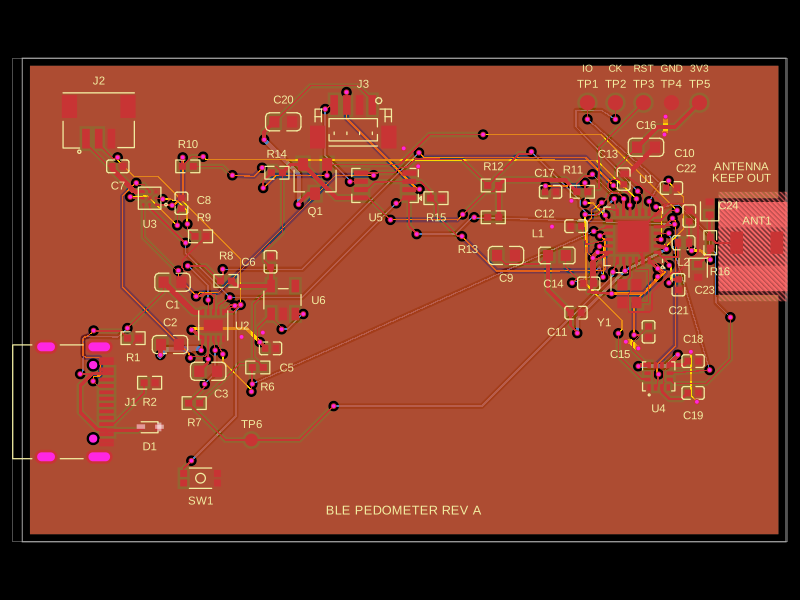 More from this authorAnasSarkiz/ble-pedometerThis code defines and configures various electronic hardware components such as surface-mount resistors, crystals, diodes, transistors, connectors, and switches with their physical footprints, schematic symbols, and 3D CAD models for PCB assembly.
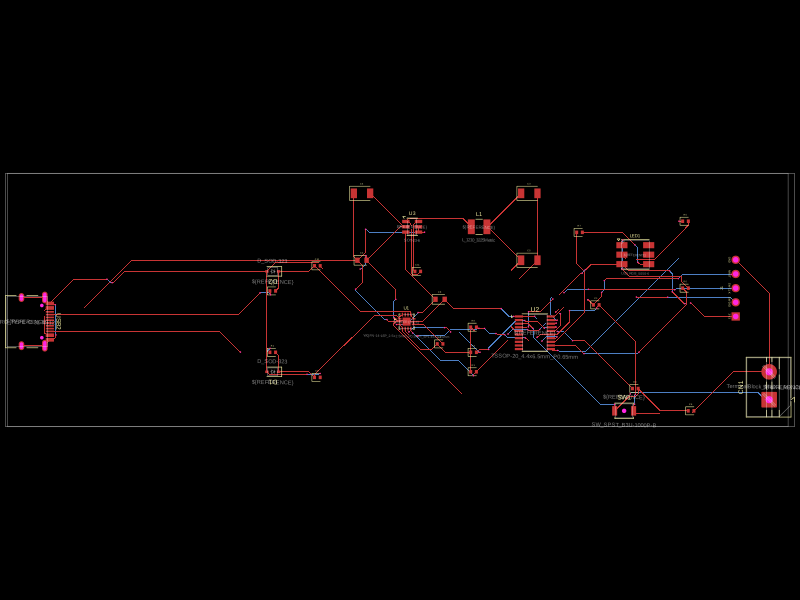 Similar packageaura/diy-power-delivery-triggerThis hardware design implements a USB Type-C port with supporting power management and signal conditioning components, including a USB-C connector, a FUSB302 USB-C port controller, ESD protection diodes, a buck converter for 3.3V power regulation, an STM32 microcontroller for control and processing, an RGB LED indicator, push button, terminal block connections, and associated filtering and support components.
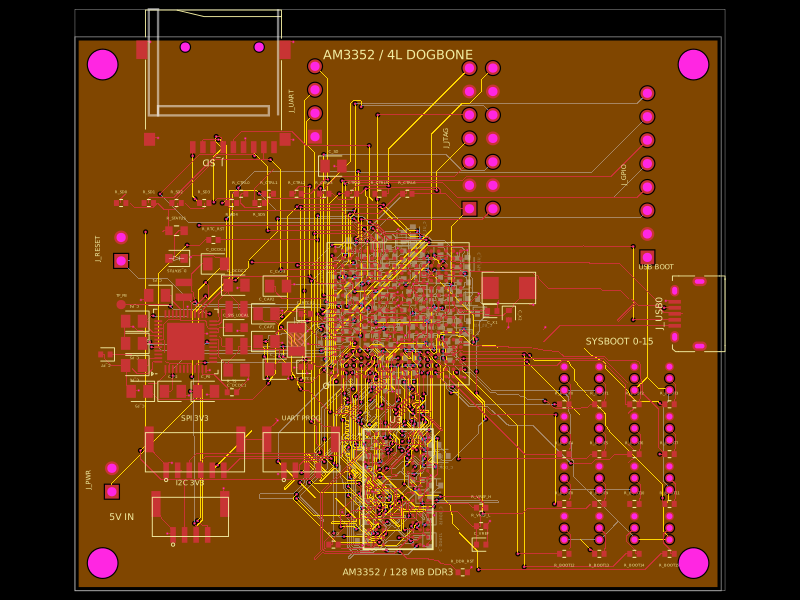 Discover something newseveibar/am3352-dev-board-4layer-dogboneDefines PCB footprints and pin mappings for a TI AM3352ZCZ100 processor, JST GH connectors, and assembly-part lookup helpers for capacitors, resistors, and headers.